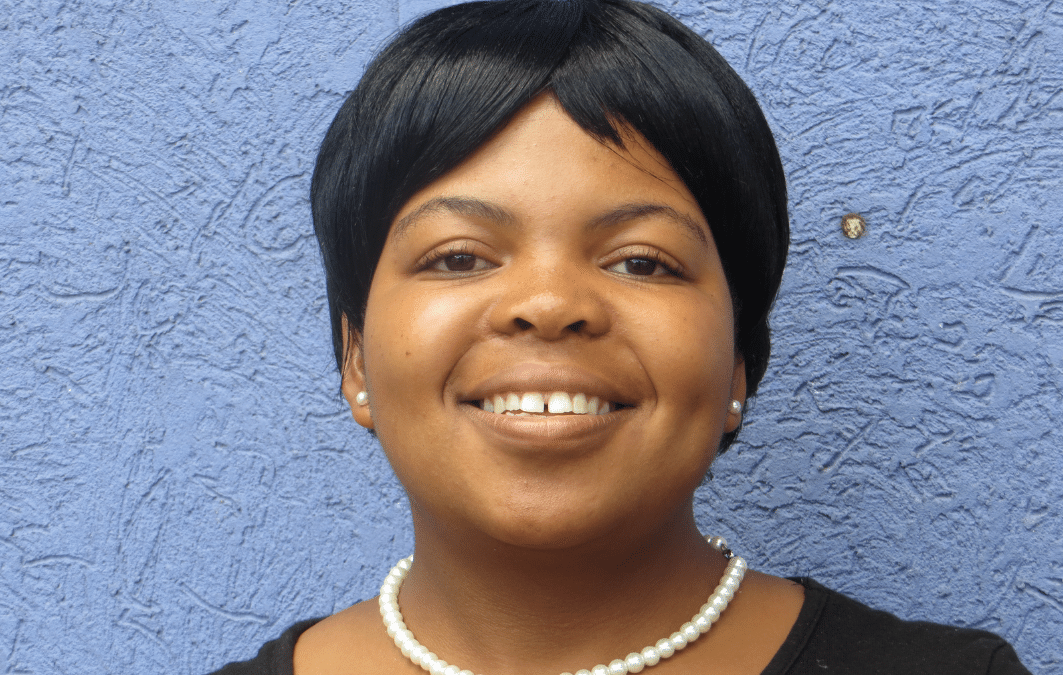
Tebello is a bright and vivacious young woman who embodies the very best of Lesotho’s leaders of today! From the time she was in primary school, Tebello has been an active participant in Help Lesotho’s programs. Below you can read a touching tribute from Tebello to Help Lesotho.
Tebello on graduation day, after completing her Master’s Degree in late 2020. As she says – #MakeEducationFashionable!
“As we #MakeEducationFashionable, I want to celebrate millions of people who “gave” money for me and others to have access to this education. Sponsors who gave not because they had plenty, but because they were passionate to restore our dignity as children. I was a beneficiary of the “Child Sponsorship Program (CSP), a program by Help Lesotho. They paid for all my school fees from Form D-E, made sure that I had good school uniform and shoes, books, textbooks and tse ngollang!
Help Lesotho didn’t just give me money, they exposed me to numerous educational programs: young women’s conference, and leadership conference. After one of these empowering programs, I gained my self esteem… And I started singing at school assembly, that’s when I started growing my school talent. I never looked back, I became a better person, grew up knowledgeable about who I am, my rights and responsibilities, my purpose.
I learned a lot about HIV, and how I can participate in addressing the problems that come with it among the youth and the entire community. I also learned how to make better choices regarding my own health, so that I can be healthy, and support those infected with HIV. I have been working in an HIV care and treatment setting, and I am proud that I get to give back to those who need my services the most. As a pharmacist, I know that my attitude towards patient care determines “the overall outcome of patient care is it doesn’t matter how everyone is working hard in the heathcare setting, if I don’t have a right attitude to serve… My patients won’t go home with optimized care. I am glad that the seed someone planted in me since 2007 is bearing fruit in my area of practice daily.
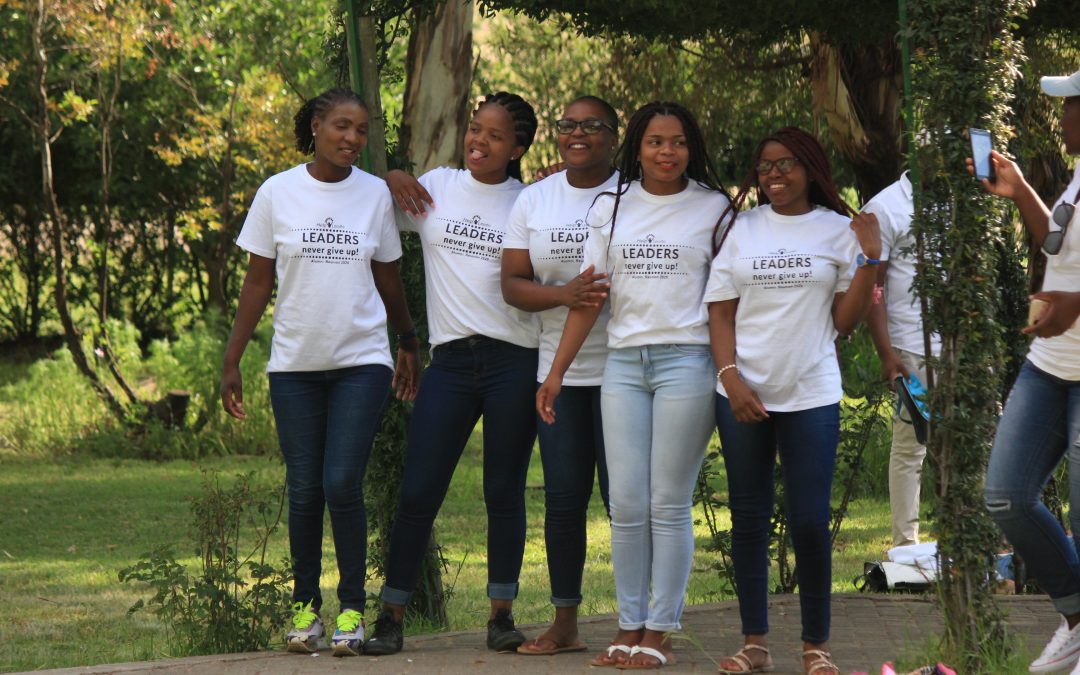
Tebello and Peg Herbert at the Help Lesotho Alumni Reunion, February 2020.
I always celebrate how the adolescent and young girls’ programs are designed and framed to respond to real time challenges of youth in our beautiful country.
If Help Lesotho had not ministered hope in my life, maybe I would have been a victim of ‘childhood marriage’ that is very prevalent in the rural areas in Lesotho. As I celebrate a mile stone of graduating with a Masters Degree, I want to make Help Lesotho famous for shinning a light on my young life, and ministering Hope, so that I could become this unstoppable young energy that I am today. God has been soooo goooooood to me for giving me favour with you.
It was a journey worth taking, experienced a lot of challenges, from financial constraints as a self-sponsored student, balancing work, social life as a young girl, supporting my family…yet God helped me through it. I am forever grateful for the influence Help Lesotho has had on my life -and I apply all the principles in my life daily. First in 2007,I was taught to affirm myself that“I am wonderful”, and I was taught that I should Step up, and Speak Up…and most importantly, It’s a principle of my life that“As a leader, I should never give up”! Thank you very much for the counsel, prayers and all forms of mentorship and support-I intend to make you proud ALWAYS!”
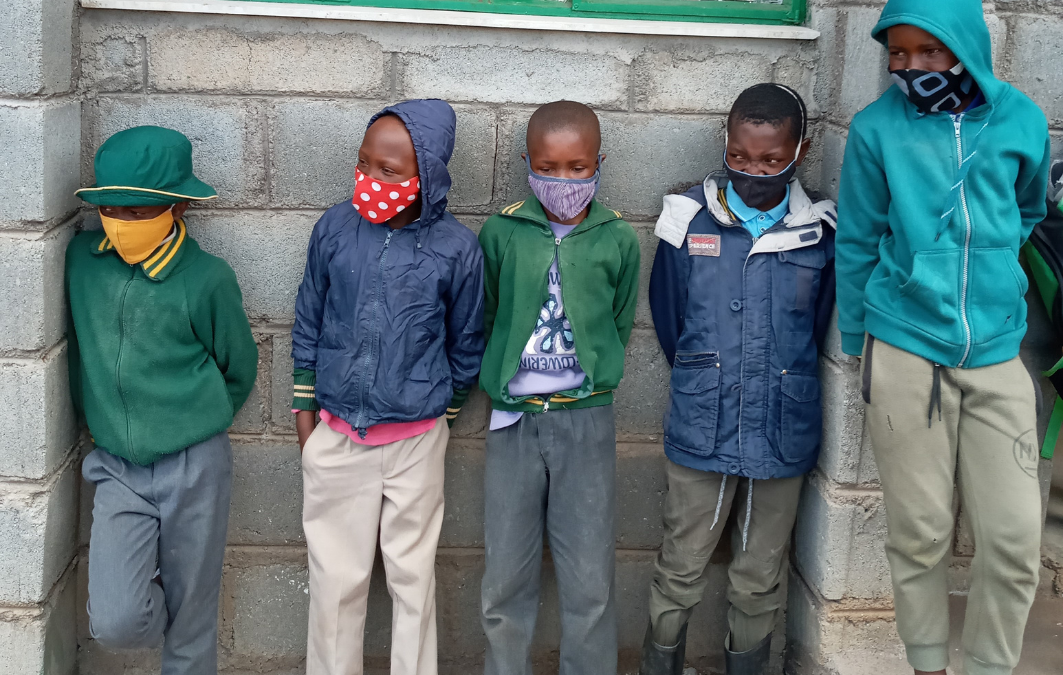
Help Lesotho continues to adapt to the changing COVID-19 landscape. As of September 2020, we are delivering programs that allow for physical distancing and that comply with current Lesotho government regulations for gatherings. Staff and participants wear masks and practice good hand hygiene. All programs now include COVID-19 education and opportunities for participants to ask questions and clarify myths. Many vulnerable people have little access to information which can lead to increased anticipatory anxiety in such a crisis. Providing clear information and strategies for managing stress is proving to be a highly impactful COVID-19 prevention strategy. Our staff continue to provide psychosocial support to beneficiaries regarding the many challenges they face, some related to the COVID-19 pandemic, others the result of the ongoing HIV/AIDS pandemic and the extremely high rate of gender-based violence entrenched in the country.
Caring4Caregivers Campaign Update:
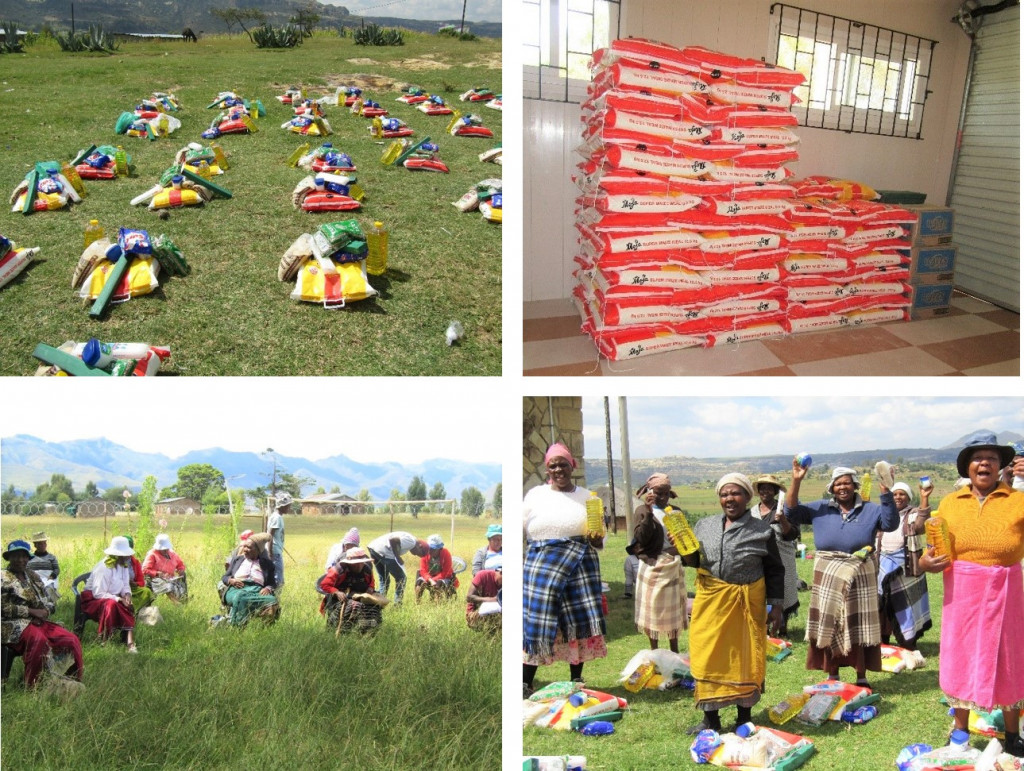
The Caring4Caregivers campaign was launched to provide relief to already vulnerable families in Lesotho were struggling to meet their most basic needs. Because of the incredible response from the Help Lesotho community, 1,230 families – over 5,000 people – received the most substantial relief packages Help Lesotho has ever distributed.
The procurement and distribution to remote villages was a massive undertaking, but we are proud that the comment we heard over and over again from community leaders and village chiefs was ‘Thank you for doing this right. You reached the people who need this support more than anyone else. The package contained the items that were truly needed [rather than things that were easy to get and give]’.
“Hi, I am Makheleli, a proud Help Lesotho participant of the young mothers’ program. Proud because I feel blessed to have experienced this indescribable opportunity. I got a call from our program officer a few weeks ago amidst the lockdown due to the covid-19 pandemic. It was a calming conversation where she only contacted me to know how my family and I were doing and we discussed coronavirus in depth so I could understand it better. I felt relieved and relaxed to the extent that I found myself sharing with her my challenges. The only income we had was from my husband’s piece jobs in fixing cars, but it has been difficult coping since we have no income whatsoever during this hard time. I am 24 and got married in 2017. I live with my parents-in-law, brother-in-law, my husband and our 1 year and 8 months old baby girl.
A few days ago I got another call and the program officer informed me to come receive a food package consisting of maize meal, soap, sugar beans, sugar, cooking oil, split peas, green lentils, salt, matches, candles, Vaseline, paraffin, oranges, apples, airtime, a mask and sanitary kit. I could not contain my excitement nor wait to get home and share with my family the grace that had fell upon us. I wholeheartedly appreciate the mercy Help Lesotho has shown us. I am capacitated not only with tangible items but information that helps my sanity and health stability.
Though we missed some of the monthly trainings during the lockdown, I treasure the discussions we had that built me into the woman I am inspired to become. Thank you Help Lesotho!”
August 21, 2020:
Lesotho was one of the last countries in the world to get their first positive COVID-19 test. Sadly, the rate of infection is climbing steadily and there are now over 1,000 confirmed cases in the country. Testing numbers are still low however the rate of positive tests of those who get tested is shockingly high at between 7-10%. The country has introduced a prevention and response strategy that restricts gathering sizes and duration, but businesses (and NGOs!) are allowed to operate (unlike during the earlier lockdown). Today the government announced that schools will reopen for specific grades in the coming weeks.
Help Lesotho’s staff are providing support to help people cope with the anticipatory anxiety that many are feeling. We continue to provide COVID-19 related education at all possible opportunities. UNICEF recently provided funding for us to create and print a booklet for young mothers to help them make the best choices they can during pregnancy, breastfeeding, and caring for young children.
At Help Lesotho, we are doing our best to resume programming that meets the government’s guidelines. It is far from ideal, but our staff and beneficiaries understand the need to protect one another while continuing to build skills for a brighter future.
July 20, 2020:
Lesotho has re-entered a country-wide lock-down after reporting nearly 400 coronavirus cases. Health officials have confirmed there is community spreading, and is urging Basotho to avoid any sort of gatherings (including weddings and funerals), and prohibiting unnecessary movements across districts (except emergencies). The borders between Lesotho and South Africa are now closed.
In order to keep one another safe, it’s imperative to wash your hands, wear a mask and abide by social-distancing rules.
April 22, 2020:
Lesotho’s first lock-down lasted from March 29 to May 6. And was originally lifted after reporting zero cases of the virus. In April, the country able to set up its own testing facility (previously all tests needed to be sent to South Africa).
Basotho are terrified, burdened with the still open wounds from the horrors of the AIDS pandemic. Among the salient factors are: inadequate national health services, small crowded homes, loss of jobs in an abject poverty context, increases in isolation, domestic violence, and sex-trade activities for girls and women who cannot feed themselves or their children, virus myths and misinformation, and the fear of death of those with severely compromised immune systems.
Our work over the last 16 years has rebuilt hundreds of rural community support networks for our youth, grandmothers, young mothers and herd boys to replace those fractured or completely destroyed by death, fear and discrimination from the HIV/AIDS pandemic since in the 1990’s. During this time of uncertainty, we are developing alternative plans to continue to bolster these community networks so they are strengthened rather than diminished by this new virus threat.
OUR RESPONSE
Help Lesotho staff are disseminating factual information about the virus, clarifying protective measures of social distancing, hand-washing, and strategies to help citizens keep their immune systems strong;
staff also developed an COVID-19 information sheet in Sesotho;
our two community centres are now closed to limit exposure from congregating;
staff are united and committed to exploring innovative ways to keep in touch with their participants;
our Country Director, Shadrack, has evacuated to Kenya to be with his family, and works from home there. Supervisors are working remotely while still supporting their staff, tracking issues and beneficiary contacts, identifying patterns, etc.;
Lesotho staff continue their weekly meetings on Tuesdays via Skype to remain focused, motivated and in close contact. They will have access to real-time information to disseminate to beneficiaries;
before the lockdown, food parcels were delivered to our grandmothers in Berea and Pitseng;
we have operationalized a communications plan and support materials through which our program staff are reaching out to deliver psychosocial support to strengthen the hundreds of village support networks we have developed over the last decade;
we have enhanced mechanisms to provide staff with airtime to hotspot their computers as none have internet at home to work remotely;
we have set up WhatsApp groups of thousands of beneficiaries for positive messaging, information sharing and crisis management;
we’ve worked to refresh our beneficiary database of 3,000+ cell phone contacts, identifying the most vulnerable in each program group for priority contacting and schedules of contacts by phone, text, etc. These are adapted to those who have smart phones, non-smart phones (no apps) and those who have no phones, radios or other forms of information or who are illiterate. The latter group includes many of our grandmothers. For these individuals, we will try to reach their relatives;
developed and operationalized messaging for staff to manage these communications, including phone scripts, Q&As on the virus, strategies for handling stress, fear, depression, communicating with children, and domestic communications under stress. We are identifying those households that may be perilous for girls and women as domestic violence tends to increase under stress; and
all staff have been sent home with large quantities of COVID-19 information sheets, one pagers on various issues (human trafficking, HIV/AIDS, anger management, communication, decision making, peer pressure, etc.), our booklets on pre-and post-natal care, sexual and reproductive health, etc. We have printed thousands of copies and each staff will use them as references and will distribute them (while practicing social distancing). The guard houses at each Centre have copies to freely give out; and
Canadian staff are all working remotely, where we continue to adapt and support from our homes.
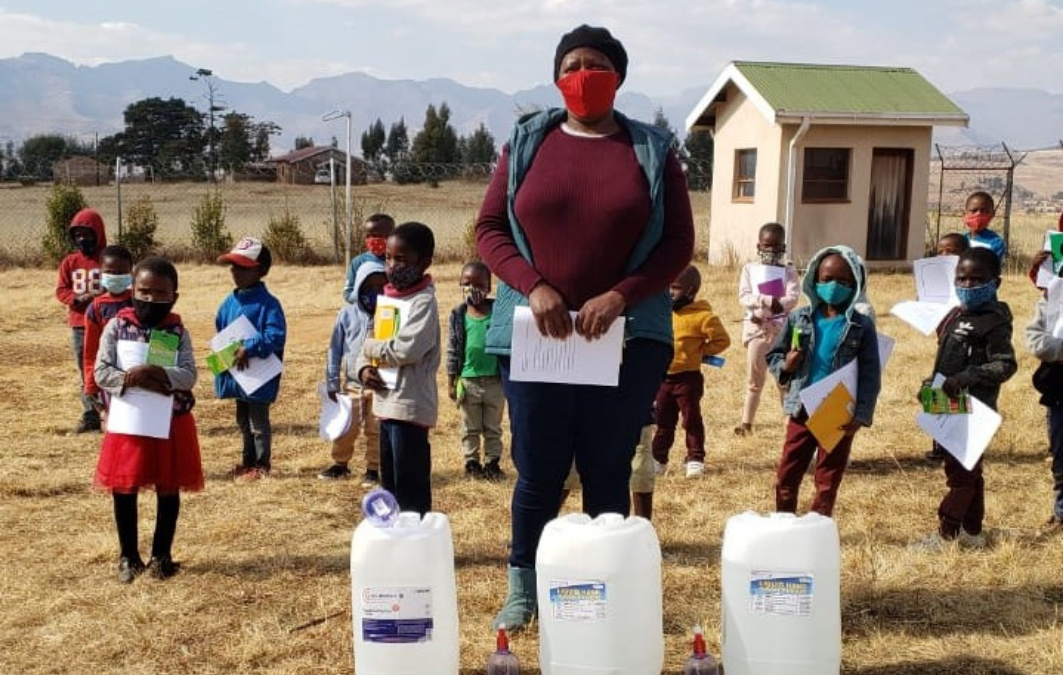
Lesotho staff distribute information sheets on COVID-19, while practicing social distancing.
HOW YOU CAN HELP
Help us with our cash flow: After building up this organization from nothing, we want to preserve and support our highly trained staff over this difficult period, who have no government support benefits such as unemployment insurance or government bailouts. If you can help us continue to keep paying our local staff and keeping the lights on, it would be most appreciated. Of course, all our budgeted spring fundraising events and plans are now aborted. We appreciate a one-time donation but if you feel you can start a monthly donation, this will give us the predictable revenue needed to enable us to continue planning our interventions for the immediate and long term periods.
Encourage our staff and beneficiaries: If you would like to write a note of appreciate or support to our beneficiaries and/or staff, please do – it would mean the world to them. You can send that to info@helplesotho.org and we will distribute.
Since 2004, we’ve been working hard to empower children and youth in Lesotho to create positive social change in their families and communities. Over 220,000 vulnerable Basotho have benefited from our programs, and over 40,000 have graduated from our intensive programs. We continue to build a critical mass of people who are committed to stop gender-based violence, protect human rights, reduce HIV discrimination and ultimately create a brighter future for Lesotho.
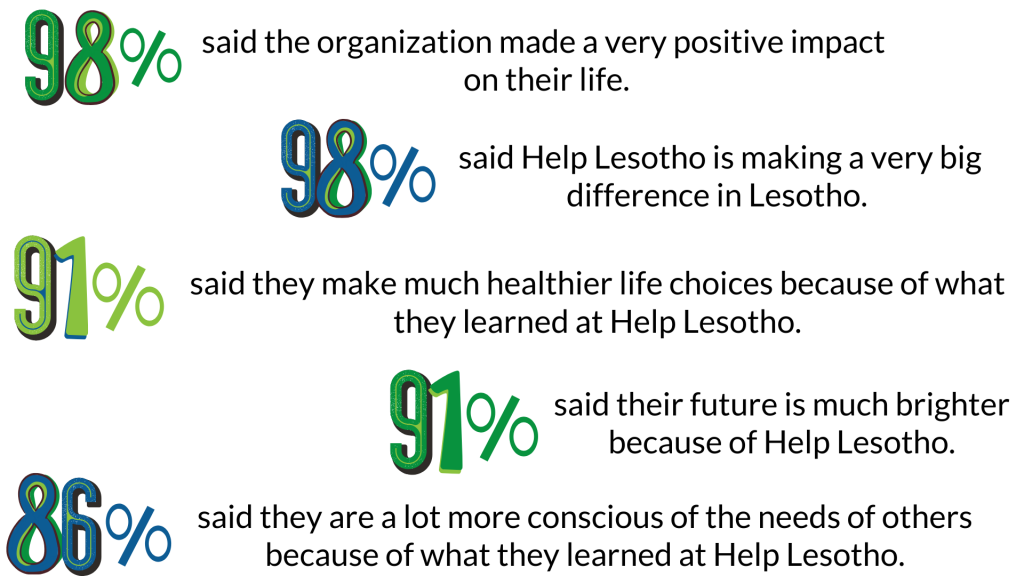
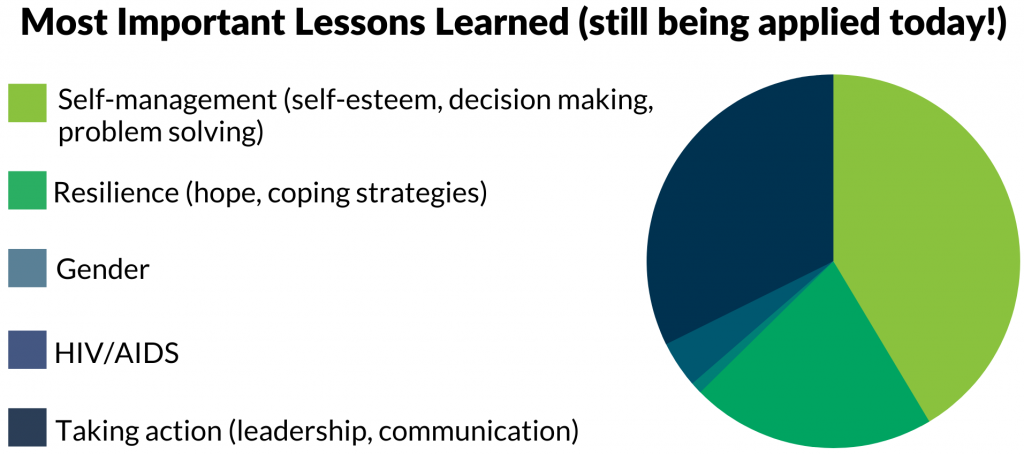
The following data was collected in early 2020 at an Alumni Reunion using surveys and written testimonials from 182 graduates of several Help Lesotho programs. It is often difficult to collect long-term program impact data due to the transient nature of our program participants. After a program ends, tracking people down to check in with them is challenging (they change phone numbers, don’t have data on their cell phones, move, etc.). This data shows that Help Lesotho’s programs are indeed creating lasting changes. It is thanks to the generosity of our donors, sponsors and supporters that we have been able to make such an impact.
All Help Lesotho programs are built on the principles of creating positive social change through building resilience, fostering self-management and encouraging strong, positive leadership skills. The graph below depicts the most important lessons gained at Help Lesotho that alumni are still applying in their lives and communities today.
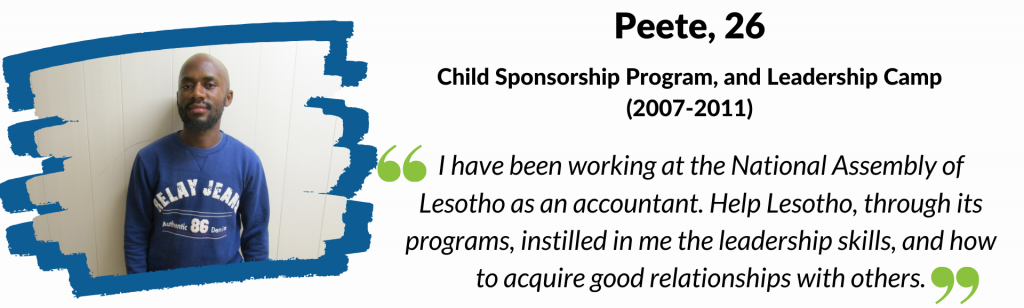
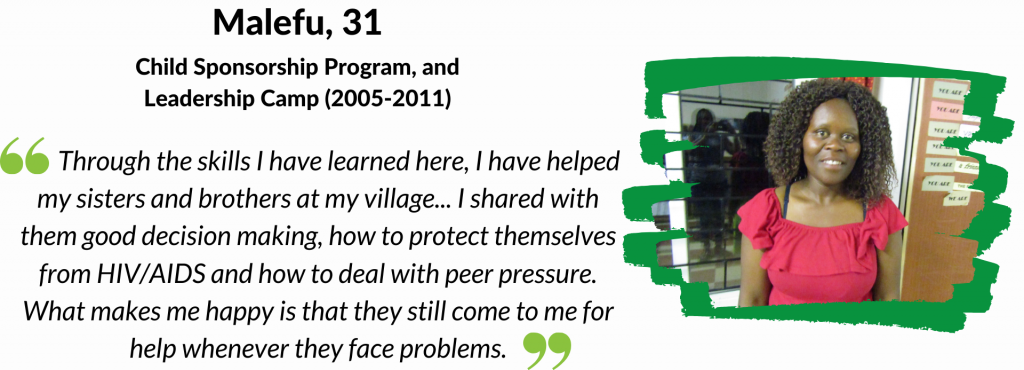
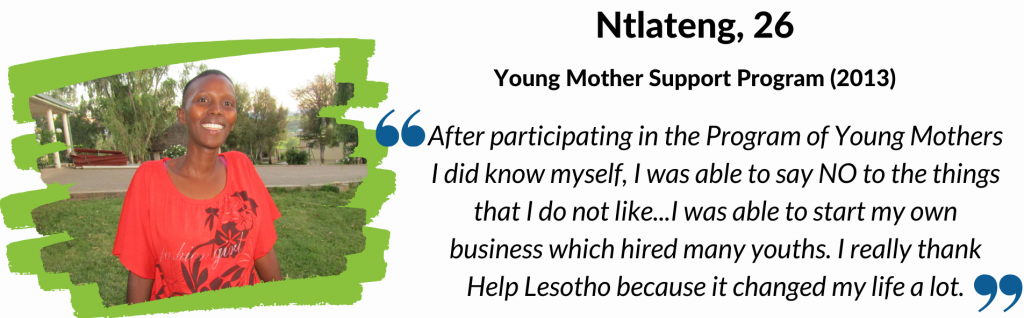
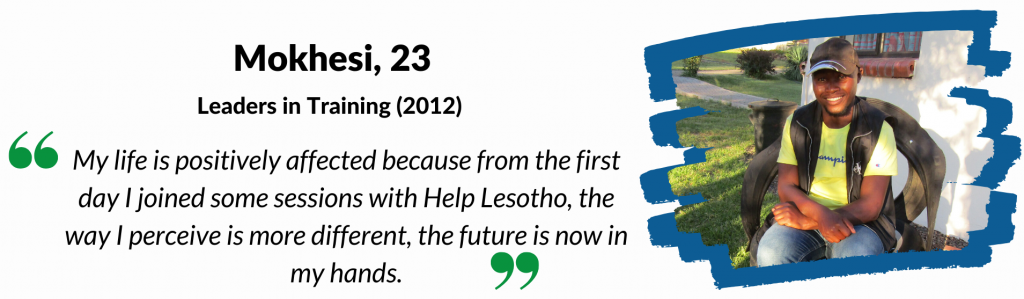
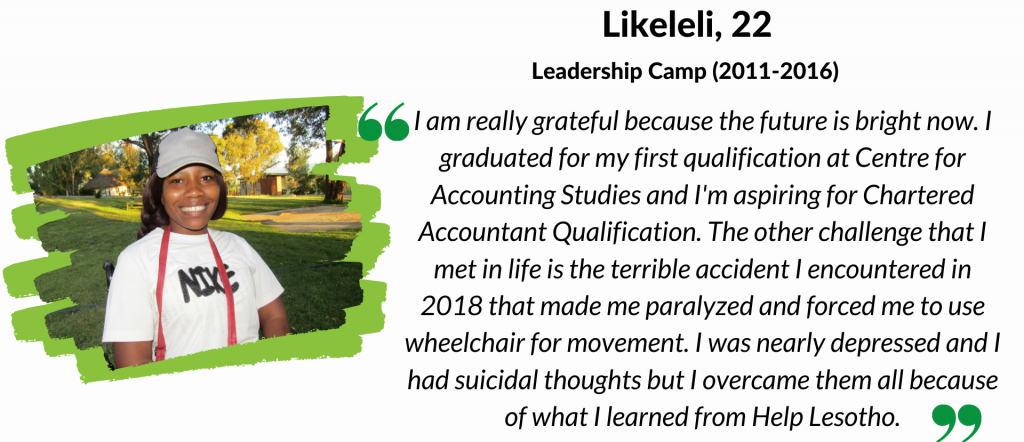
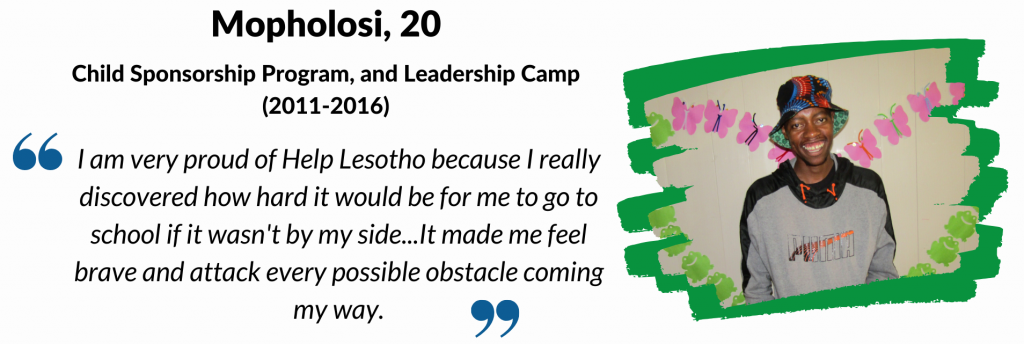
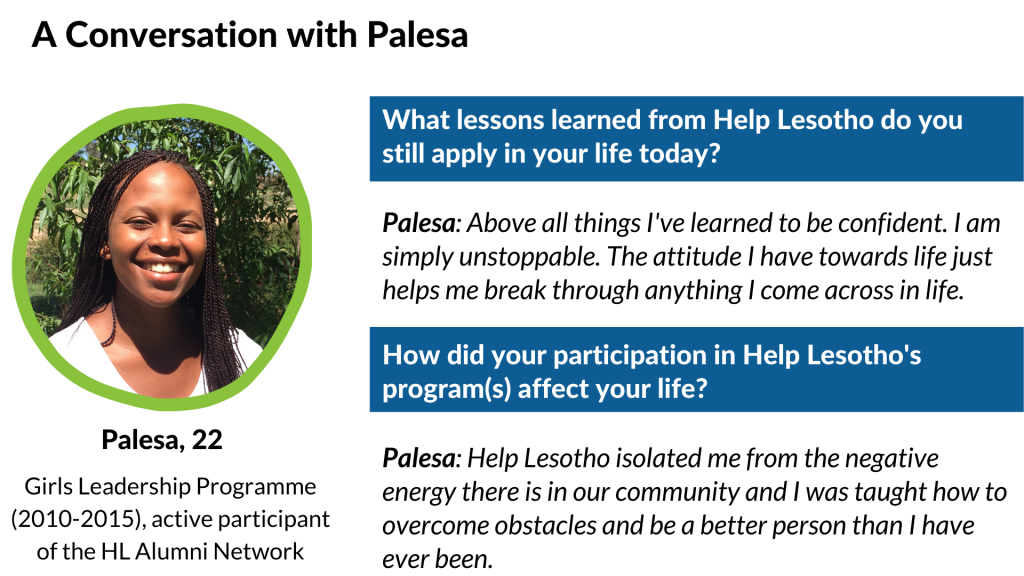
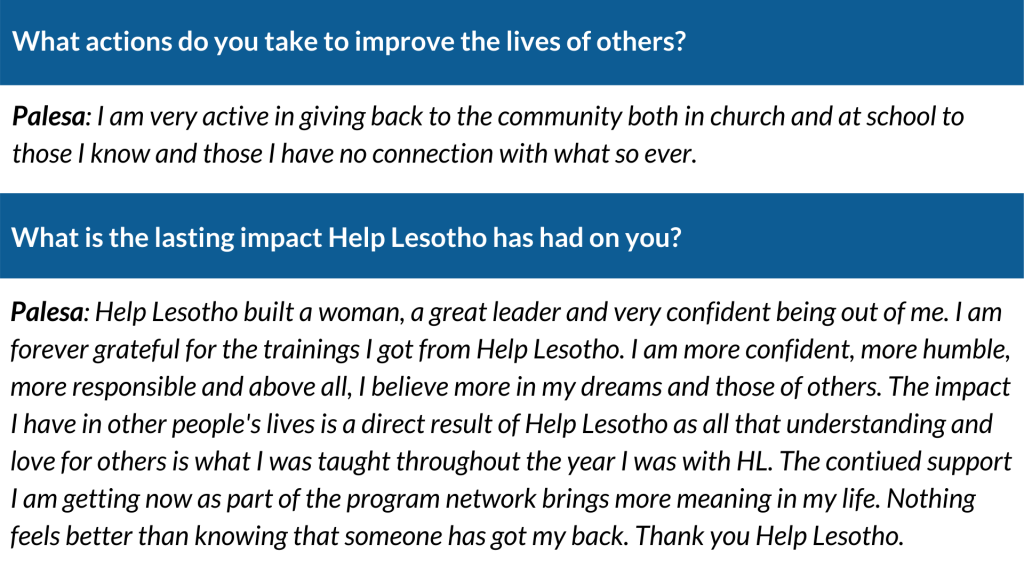
The testimonials below are from a few alumni speaking to the impact Help Lesotho has had, and continues to have, on their lives. It is our hope, and that each program graduate, continues to spread the knowledge gained from their time at Help Lesotho long after they leave our programs. Through the feedback gathered, it’s evident that this is happening!
On June 4, Help Lesotho’s Executive Director, Dr. Peg Herbert , chatted with four local staff in Lesotho to hear about how the distribution of relief packages funded by the Caring4Caregivers campaign is going. Enjoy the recording of the session!
Lesotho’s lockdown was lifted at the beginning of May. The border between South Africa and Lesotho remains closed, yet, hundreds took the chance to cross illegally back into the country. One week later, Lesotho reported its first confirmed case of COVID-19.
Despite the endless news on the devastation coronavirus is causing throughout the world, there is not enough emphasis on the impact COVID-19 will have on girls and women, particularly in a developing country like Lesotho.
As is common around the world, girls and women in Lesotho carry the brunt of housework, including the role of caregiving for children, the ill and the elderly. Their role as caregivers puts them at an increased risk of developing infectious diseases like COVID-19. As a result of this pandemic, these girls and women toil endlessly under the burdens of caregiving under the loss of income, food insecurity and isolation from the support structures that typically enable them to cope with their challenges.
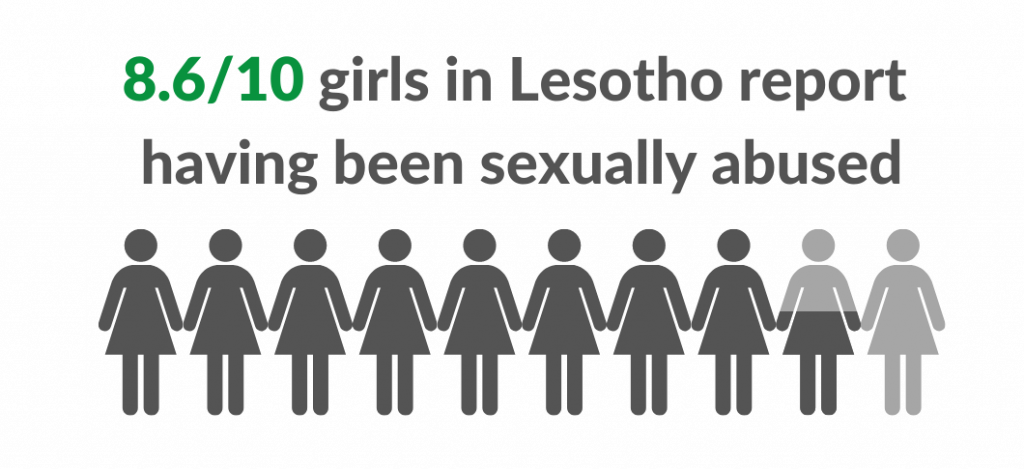
Lesotho remains under strict physical-distancing measures. With families continuing to spend long periods of time together in their very small homes, girls and women are at an increased risk of gender-based violence. In Lesotho, before the additional anxiety caused by COVID-19, 86% of girls reported having been abused. As we know well, financial and emotional stress so often manifests in violent outbursts towards girls and women who have little support in normal times, let alone when home-bound while social and protective systems are not operating at full capacity.
Lesotho’s hospitals and care facilities lack significant resources and staff, making them ill-equipped to handle a pandemic like COVID-19, with Lesotho’s quarantine facilities comprised of just 148 beds. Furthermore, women in developing countries often experience a lack of access to critical health information as a result of their their socioeconomic status . As noted in a report by the The World Health Organization:
“Social, cultural, financial and legal barriers and structural gender inequalities create critical challenges for meeting women’s health needs… In many settings women have limited autonomy and decision-making power, even over their health care needs – and limited time to seek services because of their caring responsibilities.”
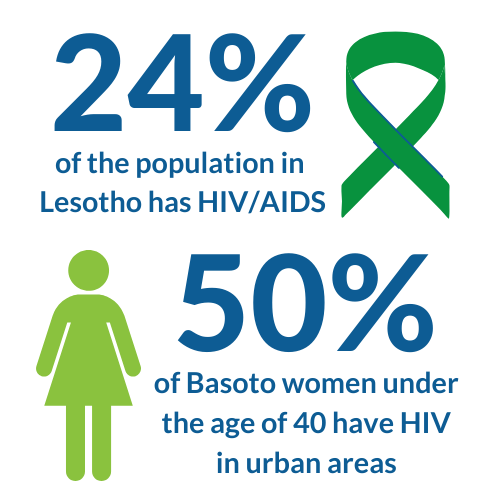
With extremely high rates of pre-existing health conditions like HIV/AIDS (24%) and Tuberculosis (695 cases/100,000), COVID-19 would be extremely damaging to many Basotho people who already struggle with compromised immune systems. For women a pandemic poses a grave risk. They are inherently more susceptible to contracting HIV for reasons related indirectly and directly to their gender. According to the World Population Review, around half of the women in Lesotho under the age of 40 have HIV in urban areas, coupled with low socioeconomic status and lack of decision making power over their sexual and reproductive health.
Many Basotho women previously supported their families through small-business income such as selling vegetables on the street, child-minding or domestic service. With a loss of income due to COVID-19 prevention measures, these women may be forced to look for work elsewhere, potentially taking risks that will compromise their wellbeing and safety. The expected desperation felt by girls and women needing to feed their families may contribute to a rise in sex work, human trafficking, and other dangerous activities.
As I write my last letter about my time in Lesotho in 2020, I am conscious of the juxtaposition we are all experiencing of incredible gratitude for every good thing in our lives and our multi-faceted anxiety for our friends, families, colleagues and global neighbours.
This blog post contains a number of different elements:
CURRENT SITUATION in Lesotho;
OUR RESPONSE update;
MY TIME IN LESOTHO; and
A concluding, very sweet letter a special volunteer wrote to you all.
Thank you for caring about our work when you have so much else on your minds. We appreciate it more than you know.
CURRENT SITUATION
April 13, the government of Lesotho released a plan to infuse money and support into the fragile economy which includes some food relief, small businesses support and some fee relief. How this will roll out is yet to be determined.
The heaviest burdens are fear, famine, gender-based violence and total loss of income. To date, there are still no confirmed cases of the virus. That said, only last Thursday a new lab opened to give the country its first capacity to actually test, financed by a mining millionaire from Lesotho, Sam Matekane. You may have read about the Canadian company, Spartan, that developed quick tests for COVID-19 with results within an hour. This type of testing has been used successfully in Africa for HIV for a decade so hopefully this will be available for African countries soon. It could make all the difference.
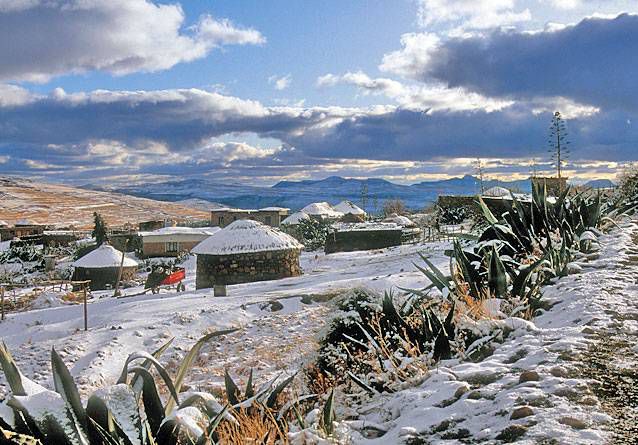
Winter is coming – as the nights get longer and colder, the need for kerosene, propane, candles, etc. increases rapidly.How the Basotho hate the cold! There are massive lineups in towns for such purchases. One wonders how it will ever be possible for our beneficiaries to secure such supplies or even pay for them.
The granny food parcel drops went well and the grannies were in tears of appreciation. Many grandmothers have no phones or means of connecting with the world.
As mentioned in my last letter, our staff were mobilized immediately to deliver remote psychosocial support to our past and present beneficiaries. In the last two weeks, they have already connected with hundreds of beneficiaries who were deeply moved that Help Lesotho had not abandoned them at this time of crisis. They have shared some feedback from their conversations:
Most report high levels of stress. Their ability to earn even a little income has abruptly stopped – no work; no pay. Women have lost the little they make washing clothes or working in the now-closed factories, no buyers for the market/street vendors, etc. They ask how they will eat when there is no money;
Police are severely patrolling so people fear going out even for essential reasons such as fetching water, checking on neighbours or visiting the health clinics. Many lack the understanding of why the police are patrolling and are scared;
Those without radios or phones are highly susceptible to confusion, myths and misinformation. Those who have access to radio are better informed;
Many people are unreachable because their phones have run out of data, or solar chargers don’t work on cloudy days, or those villages high up in the mountains have no service;
HIV positive people know that they are at much greater risk but many are not going to the clinic to get their ARV drugs, on which their lives depend, for fear of the police patrols or because they do not have the transport money;
Community conflict is increasing between the informed and the uninformed (practicing physical distancing vs not);
Many girls and women, especially our young mothers, are stressed by the sexual pressures of male partners, especially those who recently returned from South Africa and are not self-isolating;
Our herd boys have no information. If they have cell phones at all, they can only talk in the evening as the phones are charging during the day. They are so happy someone cares to know how they are;
Some believe this is the end of the world. “There’s nothing we can do about it.” “We are all going to die”.
Our trained young alumni leaders are fairly well informed and trying their best to share our information sheets and facts with their communities and to engage the deniers; and
Without consistent, fact-based information, many youth, including some of our grade seven and eight Pearl Girls and Guys4Good, continue to socialize.
We are investigating:
How we can access more washable sanitary kits as this is an increasing issue for obvious reasons; and
How we can help get food and airtime to beneficiaries in remote areas.
MY TIME IN LESOTHO
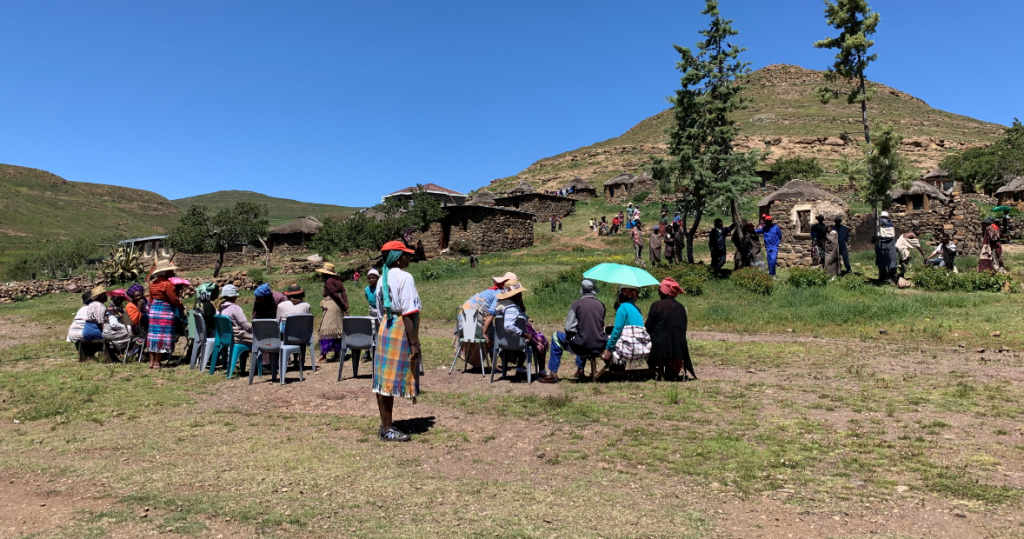
I left off telling you about the trip to Thaba Tseka with our donors. We really did have a marvelous meeting with the grannies and herd boys in their village. One of my great joys now is seeing the impact of our programs on the relationships between people.
[Staff translation]: When she was too young to remember them, her parents passed on. Her relatives deserted her and her three brothers, leaving these little ones to survive by begging for millie meal from the neighbours. At 15, she eloped, hoping for a new life. When her dear older brother passed, she became the sole supporter, just when her husband returned from his piece work in South Africa seriously ill. No income at all.
Dealing with AIDS and all that entails, she did get a chance – when she was selected for our Young Mother Program and its starter packs. Despite endless effort, her new found ability to provide for herself, her baby, her ill-husband and her younger brothers vanished when her youngest brother was attacked for refusing to go to initiation school. She overcame all this and built a successful little business with her starter money. A remarkable achievement. With her meagre income, she also cares for her cousin and her two children.
“The support I got from Help Lesotho facilitators, my peers and our support network made me a leader, made me feel loved and responsible. My little business now lets me buy food for my family and little brothers. Sadly, I had to use all my starter pack money for transport to take my little brother to hospital and then to the police station to report the case to the police. Due to a lot of responsibilities I am facing as a young woman, it is not easy at all, but I learnt a lot from Resilience and Relationships Modules which aided me to keep my family intact with all the troubles. It was hard at first to express how I feel to my husband, but now I do it with ease, and he is very supportive of me. He also went to the partners meeting which all Young Mothers partners were invited. After that meetings I saw a huge improvement on how he treats me compared to before.” – Makarabelo
Of course, now we worry what has happened to them during this lockdown. No one buys.
It was good to visit Majara School and the new classrooms Help Lesotho is building with funds from one of our previous trip guests and fundraising for furniture by Turnbull School.It is almost finished but I am anxious that the second half of the roof gets completed before the winter sets in. Everything has stopped with COVID-19.
We just launched a new program called Guys4Good, to mirror the Pearl Program for grade seven and eight girls. Unfortunately, the program started a week before the shutdown but will enthusiastically resume at the first opportunity.
The program’s supervisor, Mme Thato Letsela writes:
March 14 we had orientation training for 51 Guys4Good boys and 44 of their guardians. The latter turned up in larger numbers than expected, curious to see what a boys’ program looks like! It was sad to see how little these guardians knew about issues affecting boys. They confessed never discussing issues with them, thinking they were too young. They felt contributing to the boys’ learning was not their responsibility, but rather that of their teachers and Help Lesotho. At the mention of sexual and reproductive health, they were visibly uncomfortable. Through the discussions, they began to understand the relationship between their participation in their children’s learning and growth and the boys’ ability to make healthy decisions as they grow older. The idea of role modelling was totally new to them as well, to realize that the boys will copy their behaviour and that if they beat and insult their partners, the boys will too. They were shocked to realize that they had not been the kind of role models their boys need and had to accept blame if they did not behave. Some male guardians asked to be included in choosing the topics the boys would discuss and even help facilitate some. After their guardians left, the very popular Self-esteem session with Mme Hlalefo provided a novel opportunity for self-reflection and discussions on positive self-talk. The boys enjoyed calling themselves Guys4good during the session as they felt honoured to have been the selected few to participate in the program.
That Saturday, March 14th, at the same time as these revelations were going on in one room, a Computer and Life Skills program in another, and forty hours before I slipped out of Lesotho in the night, there were 130 children at the Hlotse Centre playing basketball, soccer, puzzles, monopoly, chess, hoola hoops, watching an educational video, and playing on the swings! There is nothing better than hearing the sweet voices and laughter of such a large gathering of children!
As I close, I will mention the obvious – we still need your support! Thank you to all those who have already donated, and thank you in advance to those who plan to do so soon. If you can help, we would be grateful.
This is the season in our lives when our values and habits define us. How we react in a crisis is both a test and an opportunity. We are reaching out to as many of our supporters and beneficiaries as we possibly can. Because we care about you – not just as a donor – but as a treasured friend. Please let us know if we can help. We will continue to keep you updated. Hope to ‘see’ you at ‘Coffee with Peg’ on the 22nd.
One of our dear supporters asked me if he could write to you all. I am sure you will find this note from Merdon as touching as we did.
Thank you for reading this letter, for caring and for walking with us through this storm.
Fondly,
Peg
Dear Fellow Help Lesotho Supporter, These very trying times bring into vivid focus the importance of recognizing what is important to you and recognizing the people who help make what you value possible. Help Lesotho is one of the things that is very important to me. I have been a monthly financial supporter and weekly volunteer for Help Lesotho for 14 years. I have had the privilege of watching this special organization blossom into a world class charity. Continuing to support the work of Help Lesotho is very special part of my life. It is incredible to see how many of my follow supporters continue to be with me year after year. I have seen firsthand the impact that your faithful support has had in Help Lesotho’s success as an organization and the vital services that they provide to the people of Lesotho and for that I would like to express to you my heartfelt thanks. It is difficult not to worry about the financial impact this pandemic will have on Help Lesotho’s funding and their work in this very vulnerable country. If Lesotho is not somehow spared the effects of this virus, the potential loss of life could be devastating. The work that we support in Lesotho will be more important than ever. I fear that this pandemic is going to severely impact one time donations. I have been blessed to not have been impacted financially. So as a monthly donor I am digging a little deeper and increasing my monthly donation. Thank you again for your continued support of Help Lesotho. I pray that you stay safe and are spared from the effects of this pandemic. Best regards, Merdon Hosking
I am nearing the end of my total-isolation period after returning from Lesotho and am so looking forward to going for a walk!
I hope you are well and managing during this stressful period. You would be surprised at how much we think of our individual donors – always mindful of your role in our story.
If you did not receive my last epistle outlining my harrowing trip home and the situation as I left it – you can access it here. I was deeply touched by your many messages of care, thank you. Please forgive me if I have not answered yet. I will soon, once we have things in place.
I had originally planned to send this letter two weeks ago from Lesotho. So much has changed in these last two weeks…but I still want to tell you about the people I met in my daily activities there. Before I continue with my Letter, you might appreciate an update about what Help Lesotho is doing to mitigate this crisis in Lesotho.
CURRENT SITUATION: To date, there are no identified COVID-19 cases in the country but I am sure that is due to the lack of testing. Tests have to be sent to South Africa to get the results. The country is on lockdown from April 1 for three weeks with Basotho living in South Africa prohibited from coming home, a measure that will significantly reduce the transmission of the virus and hopefully some domestic violence. Last Friday, a shipment of test kits arrived, complements of a Chinese billionaire. People are terrified, burdened with the still open wounds from the horrors of the AIDS pandemic. Among the salient factors are inadequate national health services, small crowded homes, loss of jobs in an abject poverty context, increases in isolation, domestic violence, and sex-trade activities for girls and women who cannot feed themselves or their children, virus myths and misinformation, and the fear of death of those with severely compromised immune systems.
OUR RESPONSE: Our staff in Canada and Lesotho have been working feverishly to prepare programs and processes that will support our program graduates and current beneficiaries. Our expertise in delivering the kind of psychosocial support our beneficiaries need most gives us an important opportunity to reach people who will most likely get no other support. It is essential to roll out our initiatives immediately to avoid the debilitating discrimination, stigmatization and myth culture that surrounded the first decade the AIDS pandemic. Our strategies will help thousands of people – directly to those beneficiaries we can reach, their families and neighbours. Some of the measures we have put in place in the past three weeks include:
Distributing food parcels, including extra soap, to our grandmothers in Berea and Pitseng last weekend just before the lockdown;
Developing a simple Sesotho information sheet on COVID-19;
Developing and operationalizing a communications plan and supporting materials through which our program staff are reaching out to deliver psychosocial support to strengthen the hundreds of village support networks we have developed over the last decade;
Mechanisms to provide staff with airtime to hotspot their computers as none have internet at home to work remotely;
Set up WhatsApp groups of thousands of beneficiaries for positive messaging, information sharing and crisis management;
Refreshing our beneficiary database of 3,000+ cell phone contacts, identifying the most vulnerable in each program group for priority contacting and schedules of contacts by phone, text, etc. These are adapted to those who have smart phones, non-smart phones (no apps) and those who have no phones, radios or other forms of information or who are illiterate. The latter group includes many of our grandmothers. For these individuals, we will try to reach their relatives;
Developing and operationalizing messaging for staff to manage these communications, including phone scripts, Q&As on the virus, strategies for handling stress, fear, depression, communicating with children, and domestic communications under stress. We want to identify those households that may be perilous for girls and women as domestic violence tends to increase under stress; and
Sending all staff home with large quantities of COVID-19 information sheets, one pagers on various issues (human trafficking, HIV/AIDS, anger management, communication, decision making, peer pressure, etc.), our booklets on pre-and post-natal care, sexual and reproductive health, etc. We have printed thousands of copies and each staff will use them as references and will distribute them (while practicing social distancing). The guard houses at each Centre have copies to freely give out.
With your help we can leverage the expertise, trust, stability and continuity we have built over the last 16 years to be a significant part of the current response and eventually the recovery process once this crisis has passed.
HOW YOU CAN HELP: Thank you for the many offers, here are some suggestions:
Help us with our cash flow: After building up this organization from nothing, we want to preserve and support our highly trained staff over this difficult period, who have no government support benefits such as unemployment insurance or government bailouts. If you can help us continue to keep paying our local staff and keeping the lights on, it would be most appreciated. Of course, all our budgeted spring fundraising events and plans are now aborted. We appreciate a one-time donation but if you feel you can start a monthly donation, this will give us the predictable revenue needed to enable us to continue planning our interventions for the immediate and long term periods.
Help us show our gratitude: One hugely impactful factor for our stability over this period is the donated Canadian office space from Hallmark RE/MAX Ottawa. Not having the burden of rent to pay is a tremendous relief. Would you write the owner, Ken McLachlan, and thank him? ken@remaxhallmark.com. We are so truly grateful.
Encourage our staff and beneficiaries: If you would like to write a note of appreciate or support to our beneficiaries and/or staff, please do – it would mean the world to them. You can send that to info@helplesotho.org and we will distribute.
MY TIME IN LESOTHO
A teaser: although I am not yet at liberty to name the person, we had a surprise visit from a very famous celebrity ambassador who came to spend half a day with our young mothers. Had I known, I would have changed my blouse!!! Once we get the go-ahead- from the publicity people, I will tell you who. That said, the person was so impressed and touched by the conversations with our pregnant girls and young mothers, asked a lot of questions and seemed genuinely moved.
Our donor trip guests visited our grandmothers and young mothers in Berea. The grannies all came in regalia – Seshoeshoe and their colourful blankets. As the grannies shared about their lives, we became tearful by the story of one Nkhono (grandmother) who had birthed 11 children and now looks after 17 grandchildren. Even by Lesotho standards this is extreme. Some of her children have passed, leaving her to care for their little ones; other children are in South Africa either working or seeking work and leaving their children with her. Now, during the lockdown, those parents will be stuck in South Africa for an indeterminate time. I cannot imagine how she manages. She said that if it weren’t for the Grandmother Program, she would have given up. It is just all too much.
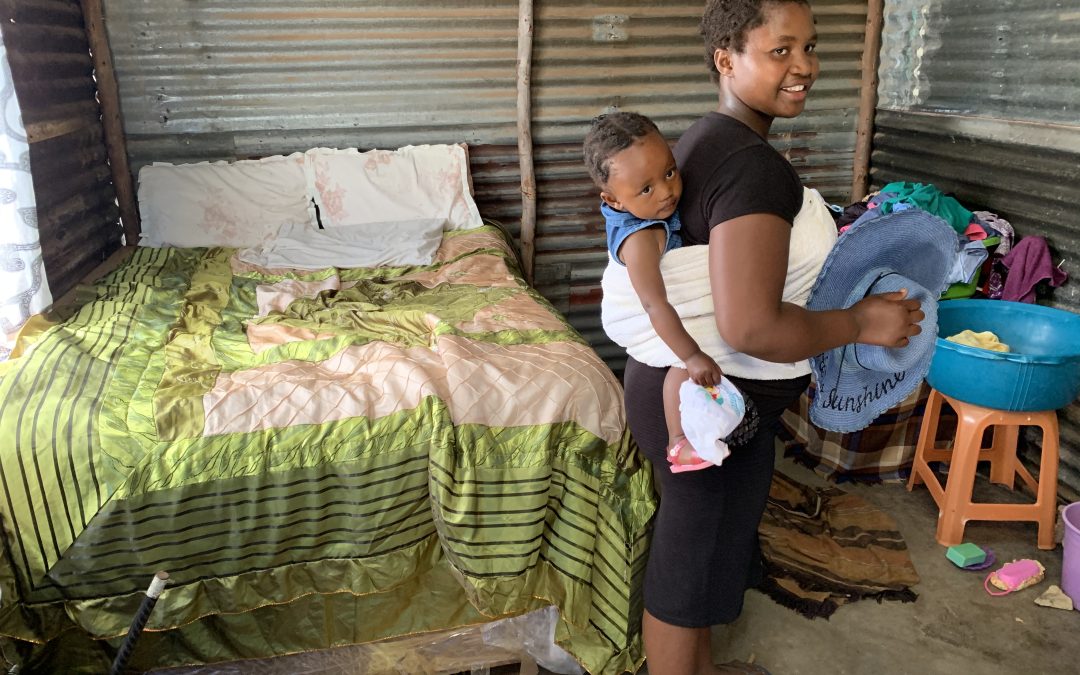
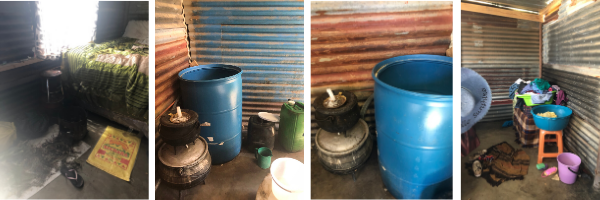
Some of our young mothers brought us to visit their homes. The walk to and from, the conversations, and chance to see what these young women deal with was moving and troubling. For example, one girl showed us her one-room tin hut – made with scraps from old rooves. It was furnace-hot in there. No place to put their meagre items. A spot on the floor to build a fire for those painfully cold nights. No bed for the baby. She had to walk such a long way to get water, yet her baby was spotless. It was humbling to hear how appreciative she was for every little bit of support we were able to provide.
As there was so much to share, I will leave the rest for my final ‘Letter from Lesotho’ #5. I close with a note from one of our trip guests, Sheryl Kennedy Fleury, who came with her lovely daughter Nora. It is important to close on a positive note.
My daughter Nora, who was with me and works in the Arts in New York, met with the GIRL4ce troupe that performs dramas about gender violence and child early and forced marriage in communities around Lesotho. When performed, it opens up dialogue about this important issue – one central to Help Lesotho’s work, and is a powerful plea for everyone in the community to be part of the solution, not perpetuate the problems. Nora offered marketing advice and pre and post-performance exercises to manage the stress that such a performance engenders. Everyone’s talents were put to use. We were truly volunteers.
We shared our experiences. With grandmothers and young mothers, we talked about our children and grandchildren. With youth training on computers and in life skills session, we talked about our careers, especially as women, and with herd boys we talked about relationships and how girls and women like and deserve to be treated.
But our most important role was to visit the communities where Help Lesotho works, listen to program beneficiaries, ask them questions about our impact and how we can serve them better, hear their stories and provide compassion, understanding and a hug.
It was a trip of a lifetime. One I would highly recommend all Help Lesotho supporters consider doing. One I hope to repeat again.
I hope you are all well and safe. I woke this morning to a cloudy, relatively warm and very safe day, in Ottawa. I want to send a note to you all on what has been going on – with me, Lesotho and the organization. Here is a COVID-19 update:
PERSONAL UPDATE
Firstly, thank you all for the messages of concern and support over the past week. To make a long, rather tortuous story short, I got food poisoning at a restaurant a week ago. Although not recovered, I decided Sunday to leave Lesotho while I could. Sylvia Pennell, a guest on our last donor trip, had remained to do some capacity building with our staff. Sylvia and I left Lesotho at 4:30am Monday morning to get across the border and drive to Johannesburg. It was so difficult to leave without saying goodbye to anyone but there it was. After the five-hour drive we spent the day in endless line ups trying to change tickets. Sylvia was able to get a flight out on KLM that night. I was not so lucky. I bought a ticket on Emeritus to Dubai, then to Heathrow. More endless line ups, and I eventually secured a ticket for two days later to Toronto and then to Ottawa. I stayed in a hotel in London near the airport, closeted in my room, from the crowd of international travelers. Heathrow is like a ghost town. 23 hours after leaving that hotel, I finally made it to Ottawa just before midnight last night, and now commence my 14-day self-isolation. I am well and grateful for the prayers and messages of encouragement. It has been a priority for me to get this update out to you as I know many are worried.
2. LESOTHO UPDATE
There are no confirmed cases of COVID-19 in Lesotho currently, however, with few/no valid testing results (tests have to be sent to south Africa for results), there is no way to know. The World Health Organization has just stated that “Africa should prepare for the worst” and labelled Lesotho one of the most vulnerable countries with at least half of the population having pre-existing conditions (such as HIV or Tuberculosis), an unstable coalition government, a preponderance of households with large families living under one roof, a returning migrant population quickly returning home from South Africa potentially infected, and a healthcare system completely ill-equipped to handle an outbreak. Schools are now closed for a month and large gatherings prohibited. Thankfully students will still receive their school lunch – for many students, this is their primary source of food.
This virus will be particularly devastating for girls and women, not because they are innately more susceptible to it, but their roles as caregivers gives them greater exposure to the virus and their limited decision-making power in most relationships will inhibit their ability to make healthy choices. These girls and women need our support more than ever as they negotiate this stressful situation.
3. HELP LESOTHO UPDATE
Our work over the last 16 years has rebuilt hundreds of rural community support networks for our youth, grandmothers, young mothers and herd boys to replace those fractured or completely destroyed by death, fear and discrimination from the HIV/AIDS pandemic since in the 1990’s. We are, even today, developing alternative plans to continue to bolster these community networks so they are strengthened rather than diminished by this new virus threat.
Tuesday, Help Lesotho staff all met to disseminate factual information about the virus, clarify protective measures of social distancing, hand-washing, and strategies to keep their immune systems strong;
Our two community centres were temporarily closed this morning to limit exposure from congregating, especially to the stream of little ones who practically live there;
Our intensive programs will continue for the next week or so as we assess the situation – these programs are so crucial to the participants and will be held in small enough groups to minimize exposure;
Staff are united and committed to exploring innovative ways to keep in touch with their participants;
Our Country Director, Shadrack, will evacuate to Kenya to be with his family while he can still get through the borders. He will work from there. Supervisors will work supporting their staff, tracking issues and beneficiary contacts, identifying patterns, etc.;
Lesotho staff will continue their weekly meetings on Tuesdays via Skype to remain focused, motivated and in close contact. They will have access to real-time information to disseminate to beneficiaries;
We will continue to adapt and support from Canada. The Canadian office is working remotely, and using the opportunity to tackle many of the projects we rarely have time to complete.
INTERIM BENEFICIARY SUPPORT STRATEGY Help Lesotho staff have developed an outstanding expertise in psychosocial support. They know their beneficiaries intimately and have built trusting, therapeutic relationships. Without home facilities or internet to work from home, they will adapt with new methods of communication to work remotely. Using our extensive beneficiary databases, program staff will soon utilize popular special media platforms, such as WhatsApp, SMS and phone calls to provide psychosocial support to alumni and current participants in their programs. They will prioritize the most vulnerable to ensure that our beneficiaries have someone they trust to talk to about their feelings and fears. Our staff will communicate current news, common-sense health information, and squarely address concerns of people who may lose the little means of support they have. This contact will provide a life line to those who need it most.
4. MY REMAINING ‘LETTERS FROM LESOTHO’
I have two remaining ‘Letters from Lesotho’ covering my time until my sudden departure drafted and will send them out in due time. They will be out of sequence given this new crisis but may provide encouragement to us all. Stay tuned for Letter #4 and Letter #5 in the coming weeks. These are unprecedented times and we have so much to be grateful for.
Again, I send my personal thanks for your caring concern. Help Lesotho is strong and focused. It is our intent to address this current situation with innovative approaches and effective support to all in our Help Lesotho family.
This is my 127th letter from Lesotho! It is hard to believe that we are in our 16th year now.
In my last letter, I shared about the alumni reunion. Since then, many young people who either could not attend or did not realize it was happening have reached out to me. It is so touching to hear their stories, successes and dreams. I wish you could hear them for yourself.
We were pleased to host Danielle Nadon and her husband Heinz Keller for five days. They were such appreciative guests – delighted with everything. Heinz is the founder/owner of Keller Engineering, a large firm in Ottawa, who graciously volunteered to come and both advise on some facility repairs and build a long-term plan to maintain our buildings over time. As you can imagine, donors don’t really want to fund such endeavours. We need to save over time to ensure these valuable buildings are in good shape to host many more beneficiaries in years to come. Although most of our work occurs in rural villages, our two Centres have hosted over 65,000 visits in the past 11 years!
I visited with Their Majesties, King Letsie III and Queen ‘Masenate last week. People might confuse the King of Lesotho with the King of Swaziland (now called eSwatini) but they couldn’t be more different. I have spent a great deal of time with the Monarchs of Lesotho and they are fine, committed role models for their people. They have no role in the political turmoil in Lesotho, and are, in fact, prohibited from participating in political activities. Many of you will have met them in Canada, along with their daughter, Princess Senate, the eldest of their three children. The Princess joined our meeting as she is now finished high school and intends to attend university in Canada in the fall.
The Princess came up to our Centre in Hlotse for a four-hour meeting with six of our youth. We had an initial brainstorming session to plan a new initiative to engage Basotho youth to restore hope and actively vote for their futures, whenever the next election is called. As in most countries, it is a challenge to get young people out to vote, but so very important. It is lovely to have the Princess as an advocate and active participant in this initiative. The participating youth were ‘over the moon’ as they say here to have this close contact with the young princess. She is greatly admired.
It was fun to watch the start of the two new Pearl Programs this month. Between the two groups there are 100 grade seven girls who will come for training to prepare them for high school (which begins in grade eight in Lesotho). They are just adorable. When people purchase our pearl jewelry, the funds go to these year-long programs.
It is our custom to welcome a small group of supporters for an intimate ‘donor trip’ at this time of year. They spend all their time with our local staff and beneficiaries. I take them up into the mountains to meet our most remote and vulnerable participants. It is a chance to see rural Africa, virtually untouched by tourism or commercialism. As I write, this year’s group of seven women are in a session with our intensive Leaders-in-Training program on grief and loss, perhaps the most, emotionally-laden, yet popular sessions we do. It is an essential opportunity for these grief-laden souls to heal and move forward.
As always, the group is interesting and diverse. Sheryl Kennedy (Toronto) has been a sponsor of numerous children since the beginning of Help Lesotho. Her daughter, Nora Fleury (New York), was in early high school when her family became involved and has followed us through our own growth. Yvonne Williams (Ottawa) has travelled widely, lived in Zimbabwe, and is relatively new to the Help Lesotho family. Nona Mariotti (Kingston) is a valued driving force in the Kingston Grandmother Connection which has raised hundreds of thousands of dollars for our grannies since 2006. Nona’s sister, Dianne Whitmarsh (Minden, ON), also is new to Help Lesotho. Sylvia Pennell (Edmonton, AB) is a behavioural therapist who has been a great support and sponsor since 2004 and a dear friend of mine for almost fifty years. Sylvia is staying longer to provide training sessions on children with challenges for our staff and teachers. Barbara Brindle (Toronto) is a managing partner of Hallmark RE/MAX Realty, the company that generously donates our office space in Ottawa. We are having lots of fun. Each guest is offering their talents wherever needed to build staff capacity and help with emerging needs.
I close this letter with a quote from Lintle, one of our alumni:
“We are here because there is no better place than home where we know we belong. Help Lesotho gave and still gives each and every one of us that sense of belong and unconditional love. We also came to say “Mama we made it”; we are surviving out there because of the skills that were imparted in us”.
I send thanks from each of our beneficiaries and staff in both countries for your financial and emotional support for this work. I hope you know how desperately needed it is here.
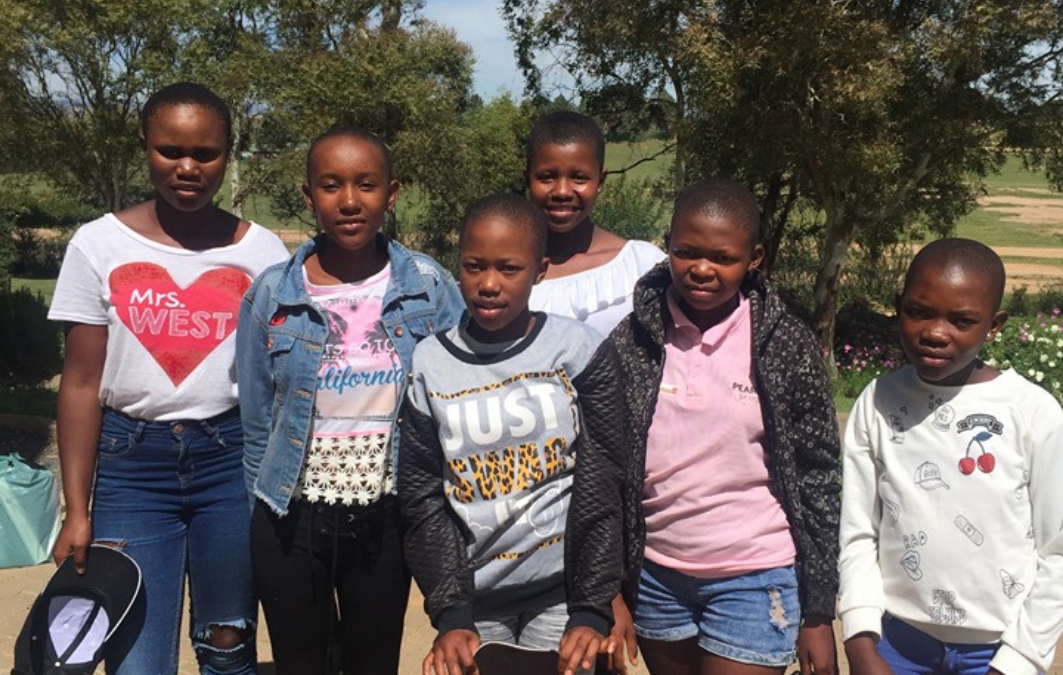
In 2019, 80 girls attended the first ever ‘Pearl Girl Camp’ at Help Lesotho’s Seotlong Centre in Hlotse. The grade 8 and grade 9 students were all from local schools and were former participants of the Pearl Program. The girls all come from vulnerable families; nearly half of girls are orphans. Help Lesotho thanks the Canada Fund for Local Initiatives (CFLI) Pretoria for granting the funds for this camp.
The goal of the three-day Pearl Girl Camp was to inspire the girls to ‘Dream Big’, especially in consideration of pursuing careers related to S.T.E.M. (science, technology, engineering and math). For many of the participants, it was the first time they realized that girls can dream big!
Here are a few of the girls’ ‘Big Dreams’ they shared after taking the training:
The girls participated in workshops where they heard from young females currently employed in S.T.E.M. industries. It was important for the campers to see girls who grew up in similar circumstances as themselves now holding important jobs in fields typically dominated by men. One of the guest speakers, Ms. Lieta, shared, “I was the only girl doing civil engineering and I failed the last year of my diploma and I was a laughing stock of all the boys in my faculty but that didn’t discourage me from trying again because I believed I am capable like those boys…”
In addition to learning about S.T.E.M., the campers participated in life skills sessions about self-esteem, being assertive, making healthy choices, leaders and followers and personal responsibility. At the end of Pearl Camp, each participant was asked to complete a survey about the information they learned during the three days of training. 96% of the girls responded that the information they learned at camp would be very helpful to their future! Survey results also showed significantly improved self-esteem and confidence among the girls, as well as an increase in their ability to make healthy decisions for themselves.
*Social enterprise Pearls4Girls sells real pearl jewelry that supports the Pearl Program. To shop, click here.















 *Social enterprise