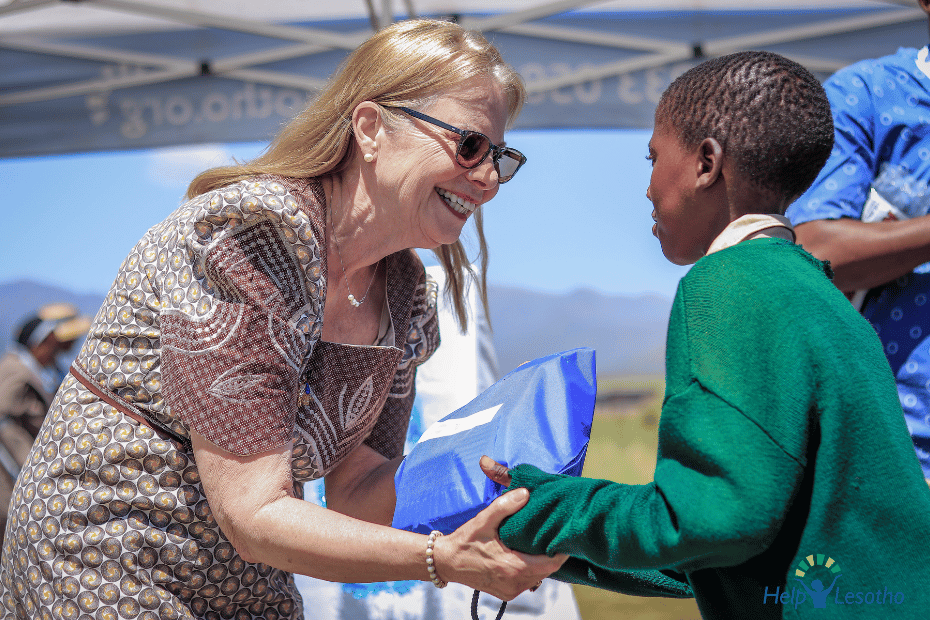
Canadian grandmother honoured for work to promote mental health in Lesotho

Canadian grandmother honoured for work to promote mental health in Lesotho

Peg Herbert began a non-profit in her Ottawa basement that is now being recognized for impacting over 274,000 people in Lesotho.

Dr. Peg Herbert, a practicing counsellor and educational psychology lecturer at the University of Ottawa, upended her life in 2000 after meeting one of her students, a nun and school principal from Lesotho, the mountainous kingdom landlocked by South Africa.

“When I first learned about Lesotho, it was during the height of the AIDS crisis in Africa,” said Herbert. “Nearly an entire generation was lost in a matter of years, leaving behind an enormous cohort of children and youth.”

Herbert traveled to Lesotho in 2004 and experienced firsthand the impacts of HIV, poverty and gender-based violence, and the compound effects of depression, hopelessness and grief. Her background in social work, academia and counselling gave her a clear vision on how she could help.

“When people are equipped with coping strategies, decision-making skills and self-esteem, they can take the necessary steps to move forward through trauma and challenges”.

The mental health needs are significant, with Lesotho having the highest suicide rate Africa according to the World Bank. Herbert’s approach to providing psychosocial support as a means to building resilience was well ahead of the curve, with Global Affairs Canada’s feminist approach finally recognizing the pivotal strategy in 2021.

Herbert’s resulting efforts, in constant partnership and communication with community leaders, quickly became Canada’s largest nonprofit in Lesotho: Help Lesotho. An all-local staff of 45 work across six of Lesotho’s 10 districts building resilience, providing mental health support and delivering life skills education for adolescents, grandmothers caring for orphaned grandchildren, pregnant and nursing young mothers, herd boys, police officers, and community leaders.

King Letsie III honouring Peg Herbert with a special gift at Help Lesotho’s facility in Hlotse.

Peg with graduated of Help Lesotho leadership programs

At an event on March 17, 2023, more than 500 people gathered to celebrate Peg Herbert. Herbert is pictured with graduates of various Help Lesotho leadership programs.

Work celebrated by generations

Herbert is being honoured in both Canada and Lesotho in advance of her retirement as Executive Director, with Help Lesotho now in its 20th year. More than 1000 program alumni, international partners and community leaders attended the Lesotho celebrations in March 2023 to pay tribute to the multi-generational impact of Help Lesotho’s programming.

Herbert was recognized by Lesotho’s constitutional monarch, King Letsie III, on March 17; “Underpinning all Help Lesotho’s remarkable achievements is all the love and commitment that Mother Peg is known for,” said the King, speaking in Sesotho, outside one of Help Lesotho’s two community centres.

Herbert’s legacy lives on through Help Lesotho’s ongoing impact under the leadership of Executive Director Kate Lambert.

Please contact or email us for high-res media photos.*
Tel:
613.369.5868

Letter from Lesotho #5 – 2023

Letter from Lesotho #5 – 2023

Greetings Help Lesotho Family,

How inspiring to be part of these last high delivery weeks in Lesotho! I’d like to shine a light on some elements of interest, indicative as they are, of our community impact.


Legacy celebration events held for Peg…

The celebration events were great expressions of joy and appreciation for ‘M’e Peg and for Help Lesotho participants, donors and programs. While I met many amazing people at these events, three were particularly memorable.

sr. Agnes

Sister Agatha, a member of the Sisters of Charity of Pitseng, and an alumnus of the Computer and Life Skills program, is proudly in her 8th decade of life. Still teaching at the high school level, she found the skills gained from the course not only valuable to her personally, but important content she shared in her classes. With her humour and acumen she is an impressive ambassador of the program.

Ntate Ts’olo Mahase is an alumni of Help Lesotho’s  Leaders in Training (LIT) program, and a model of civic responsibility. Since he graduated from LIT, Ntate Ts’olo Mahase now also holds an MBA, and is a lecturer at the local business school. Growing up, Ntate Mahase experienced the gulf in communication that existed between hearing and deaf children, and he took it upon himself to learn sign language. At the Help Lesotho Hlotse event, children from St. Paul’s School for the Deaf were present as longstanding participants in Help Lesotho programing. Their translators signed not only the speeches but the song, dance and drama that was featured. Can you imagine how wonderful this was?

Part of the way Ntate Mahase now ‘pays it forward’ is to stay connected with the children at this school. He returns periodically to visit and offer encouragement, indeed ‘M’e Kate Lambert (Director) and I bumped into Ntate Mahase again after the Hlotse event on his way to St. Paul’s, with treats in his car for the students. I was moved by his personal philanthropy, and how he embodies the personal leadership that Help Lesotho programs endeavor to foster.

Last, was the privilege of meeting their Majesties; King Letsie III, and Queen ‘Masenate, respected constitutional monarchs of Lesotho, and long time supporters of Help Lesotho and Peg. It was greatly appreciated by ‘M’e Mamoletsane Khati (Country Director), ‘M’e Peg and I to meet them informally in advance of the event, to share and appreciate their keen interest in positive development work. How supportive at the celebration event to hear the King’s expression of ongoing support for Help Lesotho’s programs ahead.


Highlights from program delivery

If I didn’t already know that the LIT (Leaders in Training) youth are visionary, articulate and full of promise, sitting in on their graduation would reveal the same. Graduation was a high emotion day as they, with characteristic powerful expression, shared experiences of growth and the program through dance, poetry, song and speech. As one graduate put it “I woke up to something exciting every day. Help Lesotho taught me to make an invitation to visit myself, befriend myself, introspect myself.” He thanked facilitators who “who were so active and free and made me feel free.” Participants talked about learning skills, building community and reflecting differently on their own lives. Many of the graduates were returning to the Hlotse Centre for Get a Job training and considering volunteering with Smart Kids.

Smart Kids is a program where Help Lesotho alumni can give back. It was designed during COVID when schools were closed. Help Lesotho’s Smart Kids program is to help pre-school to Grade 7 kids have fun while learning and feel supported as they navigate challenges. It’s been so impactful it hasn’t stopped.

julia and HL staff member

A group of us visited a Smart Kids program in Lipohong, all of the homework club were present to engage with us in the open field. ‘M’e Tumisang Mohapi is the lead facilitator of this group, a multiple-time Help Lesotho graduate who happens to be trained in home economics, and who was looking to be useful during COVID. For the past two years, in this makeshift open air classroom, ‘M’e Mohapi has been impacting children as consistently as the department of education – coaching over 40 children every afternoon and Saturday. They’ve been a vibrant learning community; working through the designated workbooks and beyond, and enjoying the positive rapport between students.

For our visit, we were treated to a poetry recital. (Note reciting poetry – like acting, demands heart.) One student recited Maya Angelou’s “Phenomenal Woman” from memory. Another shared a self-crafted praise poem to Help Lesotho. All of us visiting were wowed by their delivery, and their explanations of Smart Kids. Their facilitator ‘M’e Mohapi can aptly be described as a phenomenal woman herself for her investment of heart into this program.

Effective facilitation

It is an ongoing pleasure getting to know Help Lesotho staff, and to highlight here the work and contribution of ‘M’e Felleng Lethola, Senior Program Officer with Help Lesotho. ‘M’e Felleng is one of the calm process leaders who holds the emotional centre of groups of young people or adults with great effectiveness as they navigate psychologically tricky landscapes such as grief, addiction or assault. ‘M’e Felleng has developed ways of connecting and promoting ease and engagement with a group; using her voice with effect; creating individual bonds with people in a large group before she starts to facilitate; having relationships she can draw on and pull into strategic moments. She also uses humour and her own stories and experiences to create connection  in the groups.

It’s exciting to see the mastery of ‘M’e Felleng and how she creates with quiet authority an environment  for learning and healing. Wonderful also to hear how she is savouring working with Help Lesotho; the staff community, and the training and coaching staff receive to develop and grow. Good professionals want to work at Help Lesotho, and Help Lesotho in turn invests in its staff and their professional development and growth.

Widening the Lens: Help Lesotho in context

On this trip, I was struck by the political economy of the region, and in particular of South Africa, and how this impacts development options for Lesotho. In recent weeks, the mood in South Africa has been somber. South Africa’s stock market was grey listed at the end of February, a reputational blow to its ability to combat state capture and corruption. The mood was further dampened by months of daily load shedding (hours when electricity is rationed) as the country’s demand for electricity exceeds its ability to supply it. This is not unrelated to Lesotho, as South Africa’s Gauteng province purchases much of its water from Lesotho, and South Africa’s decaying water storage system and leaking water pipes are signals of break down and crisis in their overall management system.

As Lesotho provides South Africa with water, minerals and human resources, this regional insecurity has profound impacts. The high unemployment, health and food insecurity and climate change which affect and compel Help Lesotho’s work are regional legacies as well as national issues.

In Lesotho, however, there is an air of optimism, as Prime Minister Sam Matekane nears the end of his first six months in office. A successful entrepreneur who is bringing a business mindset to the country and has presented his goals in last month’s budget speech. This will be a defining year ahead to determine how these goals will be achieved, and how Help Lesotho programs can make their contribution in this new context.

Over the last five weeks, I have gained a deeper understanding of Help Lesotho’s offering: building resilience, strengthening mental health, as well as providing tools for healing and decision making.  These are new orientations in the workplaces of the world, as well as in the development landscape. Help Lesotho’s long track record of providing leadership development programs with a focus on personal health is a strategic and sustainable offering both for the districts in which Help Lesotho works and beyond.

mountain pic

Leaving Lesotho, the kingdom’s mountains and their distinctive sandstone crowns, is a lasting image. Layered also, the moments and experiences of the weeks. People were so moved to be together in these beautiful places and special times that phones and cameras were used in overdrive to capture surely a million pictures. Could it be though, that the best place to hold these feelings of wonder is in our hearts?  And, by staying connected to Help Lesotho’s important work ahead.


– Read Letter #4 from Lesotho
– Read all other 2023 Letters from Lesotho

Letters from Lesotho #4 – 2023

Letters from Lesotho #4 – 2023

As I begin my 145th and last letter from Lesotho, I am filled with cascading reflections from the past nineteen years, of visitors and volunteers, donors, wild experiences, challenges and the thousands of incredibly special people I have met and grown to love.

It is the time of Janus – looking backward and leaning forward. I hope I am able in some small way to convey the impact of this time of transition.  I am filled with both gratitude for all this and excitement about the next chapters for Help Lesotho and for myself.

help lesotho donor trip 2023

Our marvelous guests (Joanne Beveridge and Campbell Osler, Jennifer Parr, Deb Ruse, Nicole La Prairie, and Varsha Koneri Grant) were each a pleasure to have. We had lots of fun, power outages, water cut-offs, horseback rides in the mountains, time with kids, grannies, herd boys and young mothers. They loved Thaba Tseka – as we all do.

It was a blessing to share the opening of the Pitseng Library and celebration of my retirement with them. The tributes, traditional dancing, singing and surroundings in those breathtaking mountains were incredible. I, of course, lost it and struggled to regain my equilibrium.

peg and son jesse
peg, kate, lesley at Hlotse

Having my eldest son, Jesse, Lesley Griffiths and Kate Lambert there to share the events and staff celebrations was so special. As I write, Jesse is completing his mountain bike trek to raise money for students to finish high school. As of today, he is able to fund 20 students.

The event in Pitseng was more traditional, highly emotional and something none of us will ever forget.

peg in Basotho dress
peg with child
library plaque dedicated to peg
children dancing at pitseng
peg, julia and Sr. alice
grannies dancing at Pitseng
peg and sr. alice

It was important to share all this with my dear friends Sr. Alice and, at the Hlotse Event, with King Letsie III and Queen Masenate, and those who have supported me from the beginning. Photos with King and Queen? Due to the presence of Their Majesties, the Hlotse event was more formal. Both were streamed live on Facebook and covered by Lesotho radio and TV and print media.  Sr. Alice spoke and danced at both events with passion and aplomb!

peg and king of lesotho
Peg and queen of Lesotho

The key elements for me were that together, so many on both sides of the waters have worked faithfully, accountably and effectively for 19 years to build something that we are all proud of and totally committed to its continued growth – in impact and influence. When His Majesty addressed the media and audience in Sesotho, he commanded them to do everything possible to ensure the organization flourishes going forward. The estimated 1000+ people we hosted in total came from so far, took the days off work, and at their own expense. Many who couldn’t come sent personal greetings and messages. You would laugh to hear one speaker, a school principal with whom I have worked all this time, repeatedly allude to “celebrating Dr. Peg while she is still alive”!!!! Frankly, it did not seem that far from the truth to think of this as a type of eulogy – beyond what one might ever hear in one’s lifetime – truly humbling. We will send out a compilation of the event photos and videos in May for you as well.

matatha

One highlight was a speech but a former sponsored student, named Mathata Tlhabi. I so clearly remember my first meeting with him in a little room I used as an office in Thaba Tseka. He heard about me and came to ever-so-softly tell me about his fervent dream to be a doctor and the impossibility of achieving it, given his personal circumstances. Although I have heard that many times, I instantly believed him. I got him some anatomy books and a sponsor. He went to leadership camps and formed life-time bonds with other amazing young people. Here, about 16 years later, stood this soft-spoken, dear man in front of national radio and TV as a graduate doctor specializing in family medicine with yet another dream to study gynecology to help girls and women in his country. One life, filled with gratitude, purpose and care, given a chance becomes a force for good to help hundreds more!

I was delighted to see so many alumni and former staff – all still feeling deeply bonded to Help Lesotho. Such an overwhelming confirmation of how much people love Help Lesotho was profoundly moving. Without exception, the respondents – whether partners, royalty, beneficiaries, staff or community leaders – made solemn commitments to taking up their personal responsibility to ensure that the future and culture of the organization thrives. The staff worked tirelessly, despite a pounding storm the night before the Hlotse event, on top of their regular responsibilities – and always found time to check in with me to see how I was doing. I love each one of them. I am so proud of how much the staff have taken ownership. It is a dream for which we have worked each and every year.


I left with a deep sense of peace at what a wonderful team we have to take Help Lesotho forward under Julia’s and ‘M’e Mamoletsane’s leadership. Sharing the past month with Julia was important to us both. She takes on the role with enthusiasm and dedication.

peg and help lesotho staff

This staff photo, minus some key staff who were up in Thaba Tseka at the time, followed a tearful, tender and soul drenching time with just the staff at which we each confessed to our mutual admiration, love and respect and the importance of our journey together.

There is always so much to say, people to mention, experiences to describe but there will be other opportunities. The staff have made a comment section on our website for people to leave notes and stories through which I can respond http://helplesotho.org/comments-for-peg/.

There are also events in Kingston, Toronto, and Ottawa in April for us to share some time and stories together, get to know Julia, and visit with Kate. Please come if you can – we would love to see you.

Thank you for following these letters for so many years and for your advocacy for our social media posts over the past two months. Julia will write the next and last letter from Lesotho in this series and you can look forward to her future letters in the years to come.

I send each one my thanks and a hug,

Peg

– Read Letter #3 2023 – 
– Read Letter #5 2023 – 
– Read Past Letters from Lesotho – 

Letters from Lesotho #3 – 2023

Letters from Lesotho #3 – 2023

Greetings Help Lesotho family,

As I begin my work with this remarkable organisation, getting to know the staff and learning about the programs in more depth, it’s a pleasure to share my early observations with you. I lived the later 8 years of my childhood, age eight to sixteen, in Lesotho; the adopted daughter of Canadians. My mother was a teacher in the Lesotho school system, and my father an Anglican priest recruited by Bishop Tutu and then Bishop Mokuku to work from St James Cathedral in Maseru. Our years in Lesotho were very formative for my life and for my family. Returning now as a guest and a professional with Help Lesotho, is an absolute joy. I bring my competencies in leadership development, programing, and strategic management, and look forward to more defining years ahead.

It was a delight to meet the Help Lesotho team, and finally meet more colleagues in person, and put many names and faces together. It should not have been a surprise that an organisation expert in emotional heath and wellness would create such a bright welcome. It was nonetheless so appreciated to receive a welcome that was written, spoken, sung and danced! And that took place in the three offices of Help Lesotho – Hlotse, Pitseng and Maseru. Kea leboha and thank you❤️

I am so enjoying beginning to know staff, the arc of their professional journey, and their ‘Help Lesotho story’. Program Manager Ntate Sello Matsoso started as a participant in the Leaders in Training (LIT) program, and is now one of HL’s senior staffers and highly skilled in facilitation and program implementation. His perspectives, voice and leadership have reach and impact, and, together with other staff, are instrumental in shaping the program offerings of Help Lesotho. Finding himself in a woman-centric organisation, one of Ntate Sello’s callings is advocacy for the rights of boys and development of men. He challenges the notion that patriarchy just empowers men, when more specifically it advantages them problematically, often resulting in poor choices and decisions. He shares the example of herd boys, sent, sometimes as young as six, to look after the family’s animals, and thereby losing access to education, socialization and the provisions of the Lesotho labour code. All of these rights (and lack of access to them) shapes their future development. The Herd Boy program offered by Help Lesotho is an offering to enhance herd boy access and inclusion and has built on insights and skills of Ntate Sello and others. I look forward to getting to know all the staff through the opportunities and responsibilities we have ahead.

Julia and Sello

Visiting a partner community in an electoral district of Berea, I accompanied ‘M’e Felleng and ‘M’e Mamorena, Help Lesotho program officers, to observe a training day of the Safer Communities project. The goal is to create safer communities by building awareness of gender based violence with local leaders and service providers, and to widen the base of who will take action and respond in instances of violations.

Present for the training were community leaders, including village health workers, police, priests, teachers, and traditional authorities. As ‘M’e Felleng checked in about how the holiday period had been, several cases of abuse were raised. The discussion about how the perpetrator(s) intimidated those who should/would report was vigorous. Easy answers were not sitting at the surface, and the need to challenge norms was explored by the group. I was encouraged to learn that Lesotho’s legislature has recently (July 2022) passed a Counter Domestic Violence Bill with improved legal provisions for vulnerable people, and consequences for gender-based violence. However, we know that civil society and particularly community based programs such as Safer Communities are crucial.  Accordingly, these trainings raise awareness of rights and roles and responsibilities related to gender based violence and help increase commitment to provide action and support. Ultimately this learning group emerged with a strategy for response as well as plans for how to support for all involved.

Julia with PWRDF program group for safer communities

Safer Communities is funded by the Anglican Church of Canada’s Primate’s World Relief and Development Fund (PWRDF). This is of particular interest to me, given my father’s work for the Anglican Church, which was to build the theological capacity of people already in leadership roles who wanted to be self-supporting priests in their own communities. Some interesting parallels in the leadership development approach.

Country Director, ‘M’e Mamoletane and I have had multiple opportunities for meetings and travel, allowing for program and operational discussions, as well as some time to get to know each other. One trip was to the Pitseng Centre to meet team lead ‘M’e Thoala and understand more about the reach of the work. A highlight of the past year was onboarding and integrating a large group of children who were struggling due to a significant lack of adult support or guidance. The young students were testing boundaries only to be met by ignorance or harsh punishment. ‘M’e Thoala’s team designed intake sessions to get to know them each personally. They developed a system for not only monitoring their progress but also to start relating and connecting with a large group of young people as individuals, with individual needs for counsel and care. With her colleagues ‘M’e Itumeleng, ‘M’e Tapelo, Ntate Thabo, Ntate Peter, and ‘M’e Malehlohonolo, they move constantly between implementation and reflection so ongoing refinement of everything from programs, to resources, to grounds keeping continues to evolve, the impact of which is truly inspiring.

Julia and Mamoletsane
Julia at Pitseng
Flowers at Hlotse Centre

It has been great to be with ‘M’e Peg in Lesotho. One afternoon she took Ntate Thabo (Grounds Keeper) ‘M’e Mamoletsane and I to walk every inch of the Hlotse Centre; mapping all the property history and the evolution of buildings. Why are terraces installed behind the support centre? How have we used indigenous grasses to retain the soil and protect building foundations? How the water is separated, stored, conserved and used? How to monitor fences, surface rainflow, enviro loos, thatch, and inspection of buildings for cracks – she covered it all with us. We even learned about dreams for the land secured next to the Hlotse Centre to one day host an obstacle course for adolescents and youth. The care and consideration M’e Peg has given the Centre exemplifies her personal engagement and contribution. And as she described the role of the infrastructure she anchored it in people: “these buildings and grounds are lovingly maintained to create a sanctuary where people can play, express themselves and find healing”.

This year there are 55 diverse young people in the LIT (Leaders in Training) program. In this 60-day intensive program, this cohort of youth is developed as peer-to-peer agents of change in their communities. I joined them for several of their sessions over the past days and found them and their program inspiring. The group is keen, questioning, responsive and engaged. Building skills to navigate challenges such as suicide and grief, as well as finding ways to challenge ideas around healthy and unhealthy relationships and the rights of women, children, and vulnerable people.

I have thoroughly enjoyed different chats with the Leaders in Training group. We talked about role models growing up, playing a game to take different physical and then verbal positions on controversial statements mostly related to gender roles and expectations. As a cohort, they revel in the opportunity to differ, debate and have laughs while taking serious stands. Having delivered many leadership development programs, and as mum of an 18-year-old, I love the LIT content for participants. They are invited to normalize talking about difficult subjects and challenged to be part thereafter of breaking the silence. This space for skill building, introspection and goal setting promotes connection to self and ultimately contributions to community. I look forward to being with them again over this month ahead. 

Julia with LIT participants

As I consider my first days in Lesotho, what stands out for me, of course, is that this is also a period of transition. For individuals, transitions give us experience with change. When well managed (think rites of passage, ceremonies, celebrations) these transitions can usher us into a new chapter and new roles with preparation and confidence and a supportive community. For organisations also, transitions can offer the same, and in my view, this is wonderfully underway with Help Lesotho. While the team is delivering on HL programs, preparations are also underway to celebrate Peg as founder, leader and friend.

I am so pleased that I can join ‘M’e Peg this month, to hear her Help Lesotho stories, to be introduced to the HL family and to be brought into this rich community. Thank you for the opportunity to join the team and to help honour ‘M’e Peg. For ways for you to join the celebrations please stay posted for events in Kingston (April 13), Toronto (April 15) and Ottawa (April 22).


– Read Letter #2 2023 – 
– Read Past Letters from Lesotho – 

Letters from Lesotho 2023 – #2

Letters from Lesotho 2023 – #2

Lumelang (Greetings) to you all,

News of the winter storms across Canada makes me even more grateful that the rains have stopped this past week, unveiling the magnificent Maloti Mountains of Lesotho. Everything is green and lovely. I eagerly await the blooming of sloping fields of wild cosmos– nature’s dazzling display of pink and purple.I wish you had been in Pitseng with me this past week. This stunning valley rests at the foothills of the mountains, in which resides our smaller centre. I happened on a Grandmother Day, always a great delight, as is the opportunity to chat about their challenges and successes. They were bursting to tell me how much the program was changing their lives. Dear, dear souls!

I had arranged a meeting with half a dozen talented community leaders and retired professionals I have known for years. Three are former school principals from our twinned schools. We met in our ‘spiffy’ new library to discuss how they might involve adults and seniors in the village to come to the library for adult literacy classes, tutoring, book clubs, to be read to, discuss concerns and solutions, learn to use a computer, join an exercise class, etc.  

Although rare here for adults to believe they could/should continue to learn and grow, we talked about the urgent need to keep mature people stimulated and have a break from their tireless work to survive. We talked about cognitive decline and depression. Ironically, at the same time in the other building, the grannies were discussing dementia! They had such great ideas. They decided to call the initiative, ‘Matlafala’, which means ‘Stay Energized’ in Sesotho. A perfect name!

Our annual and remarkable Leaders-in-Training Program is in full swing. How they love these six weeks of support, building healthy friendships and resilience. One afternoon, the staff set up on the lawn to both divert and provide access to HIV/AIDS testing and family planning sessions. They started in the training room to hear from our partners, Phelisanang Bophelong HIV/AIDS Network and the Baylor College of Medicine, to learn of prevention and treatment before going out on the lawn to enjoy danceable music and activities designed to distract participants from focusing on who went to the tents for testing. It was really fun and lively – they loved it. Of the 55 youth who tested – all were negative! Isn’t that incredible. Our job now is to help them stay negative! Interestingly, one in five went for family planning advice.

On Monday morning, the staff put on a touching traditional welcome for Julia Thompson, Help Lesotho’s new Executive Director. Both Julia and the staff were delighted to meet each other after such long anticipation. The staff sang, made heartfelt speeches and gave Julia a traditional broom, a handmade gift and even messages from the beneficiaries. As they meet individually with Julia, both I and the staff are so happy to have a new leader who knows and cares so much about their culture and programs. Julia will be sharing her impressions in the next Letter from Lesotho and I know you will enjoy hearing her thoughts.

Friday, we welcome our special guests from Canada. Joanne Beveridge and Campbell Osler are two dear friends and supporters since the very beginning. All of you who receive Help Lesotho calendars will know Campbell Osler Realty, its key sponsor for 18 years. Finally, they will see our work firsthand. Jennifer Parr joins us for her nineth trip to Lesotho. Jennifer, our first board chair for ten years, remains a close friend who constantly volunteers her expertise for Help Lesotho. Deb Ruse returns to Lesotho and is a key member of the amazing Kingston Grandmother Connection which provides most of the funding for our granny program. Nicole La Prairie, also of the Kingston Grandmother Connection, and Varsha Koneri Grant, from Toronto, are both teachers and so looking forward to spending time with these adorable little ones here. We are excited to have them.

As the school year starts in January, we have all been very concerned about the disruption in the education of the students throughout COVID, as we are in Canada. January starts the new school year and as we review the results from last year, we are so relieved to know that our students in Help Lesotho’s Child Sponsorship Program have done really well. 85% of the kids passed last year – against unbelievable odds. School closures left them alone and without the social and emotional support that school provides. Many guardians can no longer scrap the funds together to pay school fees. Many students have no guardians but rather stay alone in tiny multi-person boarding rooms. Passing is a herculean feat and we applaud each one. Our analysis of the reasons they did so much better attributes it to a combination of increased psychosocial support from staff, more engagement of their guardians, access to our computers and libraries, and participation in our leadership camps after a two-year COVID hiatus.

There are so many stories. I share but two from last year; one of a beginning and one of an ending.

Khotso, high school student

Young Khotso lives with his mother, older brother and little sister. Without paternal emotional or financial support, his dream of attending high school was shattered. Reflecting on last January, when he was supposed to start his exciting high school journey, he said: “For those three months, I used to close myself indoors and I watch my peers wake up every day, all dressed up in new uniform to go to school. I avoided uncomfortable questions as much as I could”. All he wanted was to go to school and make his mom proud.

Khotso was deeply touched when his primary school principal believed so strongly in him that she paid just enough for him to join his peers at Khethisa High School in the second quarter, and bided time for his mother to plead for – and secure – Help Lesotho sponsorship from a wonderful donor in Canada. He feels truly blessed to go to school like other children. “I don’t need to be so afraid now when other children are expelled for school fees. I made a promise to make my mother and sponsor proud through my performance.” 

Khotso credits much of his success to the lack of worry, the care of the staff and to the Pitseng Centre library when he obtained position one in his class and eighth in his grade, despite missing the first term. Now in his second year of high school, he promises to work even harder. (Imagine his joy at the new library!)

On the other hand, 19 -year-old Refiloe graduated in December from our Child Sponsorship Program. “Without sponsorship, I wouldn’t never have attended, let alone graduated. I stay with my grandfather and grandmother. My father passed away and my mother left for South Africa for job hunting. She comes once in a year and we rarely communicate. We depend on grandfather’s elderly pension but he is sick. I am responsible for the collection of grandfather’s medication during his checkups”

Distance and workload meant that Refiloe moved to a hostel room close to the school, wracked with worry about her grandparents’ well-being and ability to manage on the little money they had to all share. “When I got a sponsor, I started to relax a bit and was able to achieve the outstanding results. I am so thankful to my sponsor as I was never expelled from school because of fees or not having books. The toiletry kit I received boosted my confidence as I was able to fully participate in school activities. My dream to study Law is going to come true because of the sponsorship I got at Help Lesotho.” She loved the life skills provided by Help Lesotho. She is now proud to say that her self-confidence and esteem are high to resist all the negative peer pressures. She is working hard to achieve her goals and choose friends with positive and supportive peers.

If you feel you could sponsor a student (or more than one!), you can change a life forever. It is a remarkable gift.

Humanitarian Bike Touring in Lesotho

Humanitarian Bike Touring in Lesotho

Jesse Herbert

Hey, Jesse here. March 7th, I’ll be heading to Lesotho for three weeks to celebrate “Dr. Peg Herbert’s” retirement as Director and Founder of Help Lesotho. She’s my mom and I’m a little bit of a momma’s boy, so I’m obviously not going to miss the celebrations and the opportunity to explore the mountains of Lesotho….by bike.

It turns out, one of my favourite activities is to explore foreign countries by bike, also known as “Bike Touring” or “Bike Packing”. So I’ve decided to extend my stay after the festivities and cycle through the mountains. 

There’s a lot to consider in a voyage such as this in such unforgiving, steep and hot high altitude terrain. Where do you get water? Is it safe to drink? Is it difficult to cycle at such high altitudes? How do I get in shape quickly? The list goes on.

Through February and March, I’ll be sharing the journey of preparing for this trip on my instagram channel Oopsmark where I normally share my cycling focused designs and creations. While in Lesotho, I’ll be doing my best to share my exploration of the people, the country and the behind the scenes of Help Lesotho.

I’m heading to Lesotho in Africa for some exciting celebrations, my mom’s retirement (Dr. Peg Herbert) and of course some bike packing in the mountains there. It’s sauna season here in montreal so I’m going to have to get in shape quickly. I love the rush of butterflies once you commit to something. It’s like starting down a hill in a toboggan. All you can do it try and keep up.


Planning for a Bike Packing Trip

Having bike toured in 15 countries, I’ve learned that each environment is different from the next and never what you thought it was going to be. One does their best to research the environment and prepare the right gear while leaving the kitchen sink at home. Gotta stay light  to be climbing up those mountains.
 
I have no idea what bike touring in Lesotho will be like. So many questions!
 
green arrow
How hot will it be?
Do i need a sleeping bag up in the mountains or will it be hot at night?
Can i tent along the way?
Will it be same to drink the water?
Can training under heat lamps help my body prepare for the heat and sun?
What sort of food will be available in the villages?
Should i bring pots and pans or plan to eat picnic style?
How will my legs preform at the high altitudes?
Do the Basotho people also speak English, or will I need to learn some Sesotho phrases to communicate?
 
The list goes on!
items to pack on a bike trip

Cross the Finish Line Campaign

It seemed to only make sense to include a participatory element in this trip planning. As such, we’ve launched a campaign to help kids in their last year of high school “Cross the finish Line”. Many are at risk of not being able to graduate if they cannot pay the grad fee (equal to $200 CAD). Our initial goal was to support 10 kids in graduation, although just over a week in to the campaign we’ve already raised the funds for the first 10! It’s been so exciting to see the donations roll in and all of your encouraging messages of support. Your donations will truly make a lasting impact in the lives of students!

I don’t have a particular route planned or amount of kilometers I’m hoping to bike – this will depend on the weather (Lesotho has experienced a lot of rain lately making mountainous regions prone to mud slides) and Help Lesotho’s agenda for Peg’s retirement celebrations. I will, however, try to get out as often as I can on my bike and look forward to updating you with photos, videos and stories of my time travelling the Mountain Kingdom on two wheels!

20 Years of Help Lesotho

I visited Help Lesotho soon after it started, but it’s been a while since then. I’m looking forward to learning more about what the team has accomplished and what’s planned for the future.

Help Lesotho has become the largest Canadian NGO operating in Lesotho and has impacted the lives of over 265,000 people (65% of which are women and girls) in Lesotho and raised $25 million, all without government funding. The organization is a female-led, with 40 local staff in Lesotho. Services are offered at two Help Lesotho community centres and in villages across six of Lesotho’s ten districts. Over 53,000 people have graduated from Help Lesotho’s intensive, educational programs focused on HIV prevention, women’s rights, leadership, mental health and professional training. 

Letters from Lesotho 2023 – #1

Letters from Lesotho 2023 – #1

Greetings,

Today, it is not raining! I arrived back in Lesotho in the evening, in the dark and amid torrents of rain. The long dirt road into our centre from the paved main road was so saturated that the field was flooded. Ntate Motsamai’s ability to navigate the car was impressive! The rains this season are unrelenting, unprecedented and wreaking havoc – huts crumbling, bridges breached, gardens swamped and roads washed out. It has been raining most days and/or nights since I arrived. Most of the crops have benefitted from the rain and there is hope the harvest will be good. We hope the weather will improve for the visitors and events we have planned in the coming weeks.

I felt fully ‘at home’ once I heard the all-too-familiar sound of the sheep bells just outside the centre as I began working early one morning. Sheep are emblematic here. They graze on the sides of the roads as one passes, are tethered in the small yards of villagers, are the need for our Herd Boy Program, are integral to the traditional ceremonies of killing a sheep to mark a wedding, funeral, or rite of passage, and they provide protein for privileged families and the angora wool of which Lesotho is so proud.

boy with sheet in lesotho

This visit will be close to two months and atypical for me, as it is the last before I retire at the end of April. Next week, we are excited to welcome Help Lesotho’s new Executive Director, Julia Thompson, to Lesotho. Julia is as much looking forward to coming here and meeting our staff in person, as they are excited to meet her. Donors, staff and our board join me in feeling deeply grateful to have such an experienced, capable and compassionate person to lead Help Lesotho forward into this exciting new phase of the organization. Her weeks here will be filled with visits to programs, participation in staff and partner meetings, and keen listening to the beneficiaries as they share their stories. Julia will write a couple of these ‘Letters from Lesotho’ during her time here so that you can hear directly from her. I know you will look forward to reading of her impressions and stories of her experiences.

On March 3, we will welcome our donor trip guests for an adventurous couple of weeks, during which we will celebrate the opening of the new Pitseng Centre Library to which approximately 150 of you contributed! My eldest son Jesse will also visit Lesotho in March –a real treat for me. He will be here for the Pitseng event and stay for my retirement celebration before heading out on a daring bike trek in these incredibly challenging mountains. You can follow his training and journey on his Instagram page: Oopsmark.

It was wonderful to be so warmly welcomed by the staff – I love them all. Watching them grow in their professions and skills is a great joy. Our programs are in full swing and the centres are hopping with children, program participants, comings and goings. It was special that I arrived in time to participate in the quarterly all-staff meeting and listen to the plans for the next three months – so carefully constructed to incorporate any changes or lessons learned from our extensive program evaluations and feedback from participants.

Out of School boys in their program session

Out-of-school boys starting their 6-month program.

Leaders in Training program participants gather in classroom

First-day excitement for the 2023 Leaders-in-Training participants.

This past Friday was very special and indeed emotional. The entire staff, our wonderful Country Director, ‘M’e Mamoletsane, and I spent three hours celebrating together. Some staff and professional interns received their completion certificates for the intensive Psychosocial Support Course, others their CHANGE4ce Facilitation Certification and course certificates. Nine staff were honoured with their five-year plaques for faithful service, including Bo-‘M’e Tsoakae, Hlalefo, Shasha, and Malefu, and Ntate Thabo. As I gave each a long hug, many were shaking with emotion. Among those were our three security officers (Bo-Ntate Tokiso, Lefu, Motebang and Bereng) who, on shifts, protect and support our staff, and visitors, our centre, and our participants. I wondered if these dear men, fine examples of kind and caring males to all who comes into the centre, had ever been publicly acknowledged. (Later, one told me how proud his ten-year-old son was of him when he saw the plaque.) Two Senior Program Officers, ‘M’e Felleng, our Psychosocial Support Officer, and ‘M’e Thoala the Pitseng Centre Supervisor, received their 10-year recognition plaques. ‘M’e Mampaka received our first 15-year plaque. ‘M’e Mamoletsane and I told the stories of the amazing leadership, growth and contribution of each one over so many years. These long serving staff are the foundation and stability of our programs and are mentors who train, encourage and support the others.

At each juncture, representatives of various groups spoke about the learning, growth and accomplishments of which they are so deeply and rightfully proud. Standing in front of these amazing men and women, who have bravely embraced so much training I have thrust upon them, was inspiring. Our staff face human injustice and trauma every single day. They hold these stories in their hearts and feel the weight of the responsibility of so much trust on their shoulders. They live daily with the frustration and feelings of helplessness at not being able to address all the needs before them. I thought of the many hours of emotionally-laden, fruitful conversation in their discussion groups, the ways each supports the other in pairs and groups, and the passion they hold so dear for Help Lesotho, its impact and their growth as professionals. I admire them so much – and, in the end, I just couldn’t breathe!

peg with thoala

‘M’e Thoala with her 10-year plaque.                

Peg with Motebang

Ntate Motebang with his 5-year plaque.

Peg with Mampaka

‘M’e Mampaka with her 15-year plaque.

Help Lesotho staff with plaques

Staff and professional interns pose with their course certificates!

Peg with Malefu

‘M’e Malefu with her 5-year plaque.               

Peg with Thabo

Ntate Thabo with his 5-year plaque.

Help Lesotho staff with certificates

Help Lesotho staff and professional interns proudly display their plaques and certificates!

With each day and each meeting, the stories pour out. One was about a mom, who left three little ones with a 12-year-old to go to South Africa to work and never came back. The children tried to cook for themselves and suffered significant burns. When they were brought to the attention of our staff, the latter made various efforts to support them, introduce them to the social development workers, provide emergency relief and even ensure the processes are followed to get the children birth certificates. With support from the Ministry of Home Affairs or other relevant ministry agents, we help herd boys, grannies and young mothers secure identity documents for themselves and their babies to literally ‘exist’ in the country, and which are essential for them to gain access to orphan or old age pensions, medical assistance, death certificates for inheritance or insurance.

As I close, one of my great thrills over the years is to hear from our alumni. I just received this on LinkedIn and thought you might feel proud too.

Thank you for reading along – lots more to follow.

Best wishes and a hug from Lesotho,

LinkedIn Message from Help Lesotho alumni

Peg

P.S. Just as I finished this letter – the sun came out! Yeah!

P.P.S. I wish you could hear the laughter and excitement coming from the 100 grade seven kids in the Guys4Good and Pearl Girls programs who have just arrived to begin their new year of training. They are playing basketball before their session – just adorable.

Pearl girls and Guys4Good playing basketball together
Young Mother Program Overview

Young Mother Program Overview

Help Lesotho’s Young Mother Program is a comprehensive approach to capacitate pregnant teenagers and adolescent mothers with strategies and support to cope with the repercussions of being young, often single, mothers. This involves emotional turmoil, dropping out of school, expulsion from family units, lack of support from the father of the child, stigma and rejection from family and community members, poverty, stress and livelihood insecurity. The program fosters capacity in the participants to build their personal resilience, learn to make healthy decisions, and support one another through their challenges.

Over the course of the year-long program, 70 vulnerable young mothers go on a journey of self-discovery. They challenge their beliefs, build their self-worth, become critical thinkers and take steps towards being the young women and mothers they aspire to be.

The program includes monthly training days, participant-led village support groups, individual psychosocial support sessions, the provision of baby-related care items, access to services and referrals such as health clinics and official identity documents, and entrepreneurship training alongside start-up funding for small businesses (learn more about the entrepreneurship component here).

Young mothers in Lesotho participating in a training session

Key Impacts:

  • 100% of young mothers report improved resilience.
  • Young mothers begin to treat one another with respect. Whereas at the beginning of the program the young mothers are often very harsh towards each other, at the end they actively listen, empathize and offer meaningful support and suggestions.
  • Young mothers begin to treat themselves with more respect. They take better care of themselves, demonstrate patience and grace and feel confident that they have important things to say.
  • Young mothers analyze issues with more clarity, introspection and rationality. They are able to stay calm as they discuss issues, rather than turn to anger.
  • Young mothers seek sexual and reproductive health services. They want to visit the clinics, access contraception and speak with medical professionals.
  • There is a tremendous improvement in intimate partner communication. Young mothers go from feeling helpless and undermined in their relationships to having a real say. They report that together with their partners, they are deciding on contraception and testing for HIV. They also say that they have input in the family’s finances, especially as their entrepreneurial small businesses grow.
  • Young mothers report significant improvement in their relationships with their mothers-in-law. In Lesotho, mothers-in-law wield a tremendous amount of – often misused – power and authority. Mothers-in-law are suspicious of their daughters-in-law’s at the beginning of the program, doubting that the program is worth all the time away from home. With time, the mothers-in-law come to appreciate that the improved communication skills, conflict resolution strategies, and overall increase in self-esteem all have positive effects on the family.
Young mother in Lesotho wrapped in a blanket wearing a face mask

Lineo, now 14-years-old, dropped out of school at age 13 when she fell pregnant with her 17-year-old boyfriend. Her parents, already struggling to provide for their family of 8, did not react well to learning of Lineo’s early pregnancy. The boy left the village immediately after she told him that she was pregnant and his family is hostile towards her. She has been hoping to get in contact with him but she was told that he is in South Africa attending school.

At her young age, having a child has made everything difficult. She said, “I sometimes miss being around other people of my age without carrying a baby around”.

Lineo is a strong student. She said that after receiving encouragement to not give up, she is motivated to take her life back and go to school. She said “I am still young and my mother will take care of the baby while I am at school, after attending the session on healthy relationships I feel more supported”. Having learned about domestic violence, HIV/AIDS and healthy relationships, Lineo said she feels lighter and more prepared to navigate her challenges.

Young mother in Lesotho wearing a face mask

Moipone dropped out of school in order to take a job as a nanny. Living away from her family, she sought friendship and companionship from a boy who took interest in her. Within months, Moipone realized she had become pregnant. The father denied paternity and took no responsibility to support his child.

Moipone returned home and was thankful that her family was willing to accept her back in their lives. The family support changed, however, when Moipone fell pregnant a second time. Even though Moipone continues to live at home with her parents, she says their relationship is very tense and they have not been able to resolve their conflicts well. The father of the second child is somewhat involved with raising their daughter, but not as consistently as Moipone hoped he would.

Now, a mother to two young children at 21-years-old, Moipone is feeling more optimistic for her future. “Since I joined the Young mother Program I feel lively, refreshed and I notice that I have to think thoroughly before I make decisions. Right now I have decided to use contraceptives so that I don’t have another child.” Moipone also describes significant improvement in her family relationships as they have all benefitted from understanding good communication skills to express their feelings and listen to others. Moipone’s favourite module was self-esteem because as a church-goer and choir-singer she felt down when people judged her for having children out of wedlock. “After learning about self-esteem, I have learned to take positive things and let negativity go. I have learned to better relate with other people as well. I used to be rude to male people but I have started the journey to drop the attitude and biases of them being mean, unsupportive and unloving.”

Quotes from 2022 Participants:

  • “The program assisted me to realise that I am still important as a young mother.”
  • “The information on child spacing was very crucial.”
  • “Knowing how to share knowledge and skills with other young mothers has been important to us.”
  • “The program has made us true leaders.”
  • “I only expected to be taught how to take care of my family but I learned a lot more.”
  • “I learned patience and being humble at all times.”
  • “It is important to care and love to others.”
  • “My family and my relationship has improved.”
  • “I am now able to ask for forgiveness. My future will be brighter.”
  • “I will be a role model for my daughter. I hope her life will not have so much pain as mine.”
Mats’epo’s Story

Mats’epo’s Story

Through Help Lesotho’s Young Mother Program, participants receive ‘Starter Packs’ to help them with the initial investment needed to launch small businesses. As much as these young mothers try to find jobs elsewhere, the high degree of unemployment in the country makes for an incredibly competitive job market. Additionally, most young mothers need significant flexibility in their work in order to care for their children. The young mothers find that being self-employed is the ideal scenario for them, even though it is not an easy road to success.

Along with the start-up funding for their small businesses, the young mothers are trained on budgeting, inventory management, marketing, and customer relations. While not all young mothers are able to sustain their businesses, this model remains an effective way to give young mothers the option to build a business, or to use their initial profits to meet urgent needs within their families.

One young mother, Mats’epo, used her Starter Pack to buy simbas (peanuts), biscuits, eggs, sweets and match sticks. She selected her starter pack products based on what is in demand in her local community. Many people in her community had to walk a long distance to get the products she is selling, so she knew the demand would be there as people would find it more convenient to buy from her. She made use of her profits to open a salon which is right next to her shop where she sells her starter pack products. Mats’epo says her success is attributed to her business strategy. She invests her profits back into the business to make sure that it keeps growing, and keeps thorough records of all her transactions. In the future, she hopes to learn more about bookkeeping and how she can better manage multiple business operations. She is currently looking into making jewelry with beads and believes that it is going to be a success!

Young mother in Lesotho working as a hairdresser

“The starter pack enabled me to meet different needs such as food as well as my family’s needs. I found the starter pack helpful because it enabled me to buy shoes for my child. At some point, I was struggling to buy shoes for her and other basic things.

The Young Mother Program as a whole has made me more aware of the areas I was failing in my relationship with my husband. We used to have some conflict but now I know how to handle that. Another important thing was getting tested for HIV. At first I was afraid to know my status but now I don’t have a problem going for testing. I also learned about contraception and now I know how to use contraception properly.

My business skills have also improved. As you can see, I started off with the starter pack but now I also have a salon which is doing well. It’s almost Christmas and there are many people who are going to be coming to get their hair done. I am also going to buy some beads next week so that I can start making jewelry that I will be selling to women who are going to come in the salon. The business is going to grow and do well and I thank Help Lesotho for everything.”

Mats'epo